3. Mean field theory for magnetic systems:
We will now consider the interacting Hamiltonian of spin-1/2 Ising Model. Note that the non-interacting Ising spins  in an external field H described by the Hamiltonian
  does not show any phase transition. Spontaneous magnetization goes to zero even at T = 0. There are two approaches: the classical approach by Weiss and the minimization of free energy by Bragg-Williams. We will develop the mean field equation of state applying both the approaches.
3.1 Classical approach: Weiss theory
The spin-1/2 Ising Hamiltonian in presence of an external magnetic field H is given by

where  and μ is the magnetic moment of each spin. In the classical mean field approximation invented by P. E. Weiss, the spin-spin interaction is replaced by an average magnetic field in which the spin is sitting and the field should be proportional to magnetization. The self-consistent field is then given by
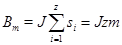
where z is the coordination number (the number of nearest neighbors) of the lattice and m is the magnetization per spin. Hence, the mean field Hamiltonian for single spin can be written as
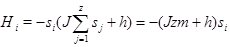
Note that all details of the lattice structure is now lost. Only z, the coordination number, can not describe a lattice. For example, both for 2d triangular lattice and 3d simple cubic lattice the coordination number is z=6. If the system is in thermal equilibrium with a heat bath at temperature T, the single particle canonical partition function is given by

where  . Hence, the free energy density is
 .
.
The per spin magnetization m then can be calculated as
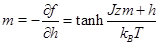
This is the self-consistent mean field equation of state.