5. XY model:
The Ising model has very restricted application to magnetic systems. The Ising spins have only two states, either parallel to the applied field or anti-parallel to it. No other orientation than up or down is possible and thus the spin orientation are highly anisotropic in spin space. MnF2 is a magnetic system where such model could be applied. However, there are many physical systems where spin orientation away from the quantization axis occur. One of the modified models is XY model where each spin is a two dimensional unit vector  . The interaction Hamiltonian is given by

where x,y are the labels of Cartesian axes in spin space. It has a conventional phase transition at a finite temperature for d >2 whereas for d=2 there is a transition at finite temperatures to an unusual ordered phase with quasi long range order known as the Kosterlitz–Thouless transition.
6. Heisenberg model:
In the case of classical Heisenberg model, the spin variables are the isotropically interacting three dimensional unit vectors. The Hamiltonian is given by
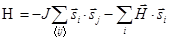
where  is the external field. The quantum mechanical Heisenberg model can be written as

where σj s are quantum operators, the Pauli spin matrices .
The classical Heisenberg model can be considered as  limit of the quantum Heisenberg model. In the classical limit, the Heisenberg spin can take on an entire continuum orientation instead of a finite number (2S + 1) of discrete orientations. The magnitude of the spin
  has to be normalized 1. Though the classical approximation is unrealistic at low temperatures, it is extremely realistic near the critical temperature
  . The critical exponents are found to be independent or very weakly dependent on the spin quantum number S and thus the spin dependence can be neglected.
The quantum models can be mapped on to classical model models in one higher dimension. There are exact results for 1d quantum systems whereas classical models are solved exactly in two dimensions. Moreover, the Heisenberg model exhibits continuous phase transition at a finite temperature for d >2 whereas the same occurs in Ising model for d > 1 .
The Heisenberg model provides a reasonable description of the properties some magnetic materials, such as EuS, and able to describe ferromagnetism.