4. q-state Potts model: In the Potts model, a q-state spin variable  is placed at each lattice site. The Hamiltonian for the spin interaction is given by
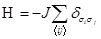
where δ is Kronecker delta. So the energy of two neighboring spins is -J if they are in the same state and zero otherwise. The ground state is q-fold degenerate. In two dimensions, the Potts model describes a continuous phase transition to a paramagnetic phase for  whereas the transition is first order for
  .
.
It can be shown that the q=2 Potts model is equivalent to spin-1/2 Ising model by replacing the Kronecker delta function in the Potts Hamiltonian in terms of spin-1/2 Ising variable as
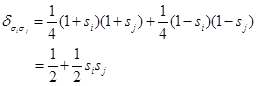
 . The Potts Hamiltonian then can be written as
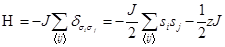
where z is the coordination number of the lattice. Therefore, the q=2 Potts model is essentially an Ising model with interaction strength  with a shift in ground state energy by
  .
.
However, the q=3 Potts model is not equivalent to spin-1 Ising model. The Potts model has a three-fold degenerate ground state whereas spin-1 Ising model with the Hamiltonian

there are two ground states and one doubly degenerate. However, in one dimension if  for spin-1 Ising model, the two models become identical.
Absorption of krypton on the basal plane of graphite can be studied with q=3 Potts model.