6. Fluctuation and response functions:
Apart from macroscopic thermodynamics quantities, statistical mechanics can also provide information about microscopic quantities such as fluctuations and correlation. Even if the system is in thermal equilibrium (constant T ) or mechanical equilibrium (constant P) or chemical equilibrium (constant μ), the energy E, magnetization M, number of particles M may vary indefinitely and only the average values remain constant. It would be interesting to check that the thermodynamics response functions such as specific heat  , isothermal compressibility
  or isothermal susceptibility
  are directly proportional to the fluctuation in energy, density or magnetization respectively.
The fluctuation in energy is defined as

By calculating  , it can be shown that

Thus the specific heat is nothing but fluctuation in energy.
The fluctuation in number of particles N is defined as

where is the isothermal compressibility. The isothermal compressibility is then proportional to density fluctuation. If  , one has
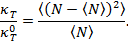
Similarly, the isothermal susceptibility is proportional to the fluctuation in magnetization
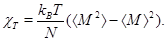
These are system-independent general results. Generally these fluctuations are negligibly small at normal conditions. At room temperature, the rms energy fluctuation for 1 kg of water is  J
J  , whereas to change the water temperature by
  degree the energy needed is
  . Since the heat capacity grows linearly with the system size, the relative energy fluctuation goes to zero at the thermodynamic limit.
The above relation shows that the responses 

 are linearly proportional to the fluctuation in respective thermodynamic quantities - this is known as linear response theorem .