5. Postulates of statistical mechanics
The principles of statistical mechanics and their applications are based on the following two postulates.
Equal a priori probability: For a given macrostate  specified by the number of particles N in the system of volume V and at energy E there is usually a large number of possible microstates of the system. In case of classical non-interacting system, the total energy E can be distributed among the N particles in a large number of different ways and each of these different ways corresponds to a microstate. In the fixed energy ensemble, the density
  of the representative points in the phase space corresponding to these microstates is constant or the phase points are uniformly distributed. Thus, any member of the ensemble is equally likely to be in any of the various possible microstates. In case of a quantum system, the various different microstates are identified as the independent solutions
  of the Schrödinger equation of the system, corresponding to an eigenvalue E. At any time t, the system is equally likely to be in any one of these microstates. This is generally referred as the postulate of equal a priori probability for all microstates of a given macrostate of the system.
Principle of ergodicity : The microstates of a macroscopic system are specified by a set of points in the 6N-dimensional phase space. At any time t, the system is equally likely to be in any one of the large number of microstates corresponding to a given macrostate, say as for an isolated system. With time, the system passes from one microstate to another. After a sufficiently long time, the system passes through all its possible microstates. In the language of statistical mechanics, the system is considered to be in equilibrium if it samples all the microstates with equal a priori probability. The equilibrium value of the observable X can be obtained by the statistical or ensemble average
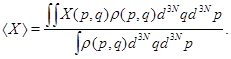
On the other hand, the mean value of an observable (or a property) is given by its time-averaged value:
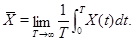
The ergodicity principle suggests that statistical average  and the mean value
  are equivalent:
  .
.