3. Statistical ensembles:
An ensemble is a collection of a large number of replicas (or mental copies) of the microstates of the system under the same macroscopic condition or having the same macrostate. However, the microstates of the members of an ensemble can be arbitrarily different. Thus, for a given macroscopic condition, a system of an ensemble is represented by a point in the phase space. The ensemble of a macroscopic system of given macrostate then corresponds to a large number of points in the phase space. During time evolution of a macroscopic system in a fixed macrostate, the microstate is supposed to pass through all these phase points.
Depending on the interaction of a system with the surroundings (or universe), a thermodynamic system is classified as isolated, closed or open system. Similarly, statistical ensembles are also classified into three different types. The classification of ensembles again depends on the type of interaction of the system with the surroundings which can either be by exchange of energy only or exchange of both energy and matter (particles or mass). In an isolated system, neither energy nor matter is exchanged and the corresponding ensemble is known as microcanonical ensemble. A closed system exchanging only energy (not matter) with its surroundings is described by canonical ensemble. Both energy and matter are exchanged between the system and the surroundings in an open system and the corresponding ensemble is called a grand canonical ensemble.
4. Statistical equilibrium:
Consider an isolated system with the macrostate  . A point in the phase space corresponds to a microstate of such a system and its internal dynamics is described by the corresponding phase trajectory. The density of phase points
  is the number of microstates per unit volume of the phase space and it is the probability to find a state around a phase point
  .
.
By Liouville's theorem, in the absence of any source and sink in the phase space, the total time derivative in the time evolution of the phase point density is given by
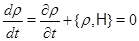
where
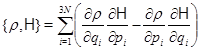
is the Poisson bracket of the density function ρ and the Hamiltonian H of the system.
The ensemble is considered to be in statistical equilibrium if has no explicit dependence on time at all points in the phase space, i.e. ,

Under the condition of equilibrium, therefore,  . It will be satisfied if ρ is an explicit function of the Hamiltonian
  or ρ is a constant, independent of ρ and q. That is

The condition of statistical equilibrium then requires no explicit time dependence of the phase point density as well as uniform distribution of over the relevant region of phase space. The value of will, of course, be zero outside the relevant region of phase space. Physically the choice corresponds to an ensemble of systems which at all times are uniformly distributed over all possible microstates and the resulting ensemble is referred to as the microcanonical ensemble. However, in canonical ensemble it can be shown that  ].
].