1. Classification of control valve according to number/ways of switching position
1.1 Three position four way (3/4) valves
Three position four way (3/4) valves are used in double-acting cylinders to perform advance, hold and return operation to the piston. Figures 5.5.1 and 5.5.2 show three position four way valves. These types of valves have three switching positions. They have a variety of possible flow path configurations but have identical flow path configuration. When the centered path is actuated, port A and B are connected with both the ports P and T respectively. In this case, valve is not active because all the ports are open to each other. The fluid flows to the tank at atmospheric pressure. In this position work cannot be done by any part of the system. This configuration helps to prevent heat buildup.
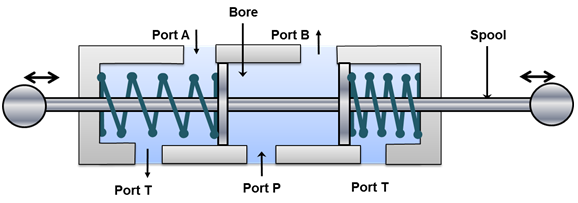
Figure 5.5.1 Three position four way valve: P to B and A to T
When left end (port B) is actuated, the port P is connected with ports B and T is connected with port A as shown in Figure 5.5.1. Similarly, when the right end is actuated the port P is connected to A and working port B is connected to port T as shown in Figure 5.5.2. The three position valves are used when the actuator is needed to stop or hold at some intermediate position. It can also be used when the multiple circuits or functions are accomplished from one hydraulic power source.
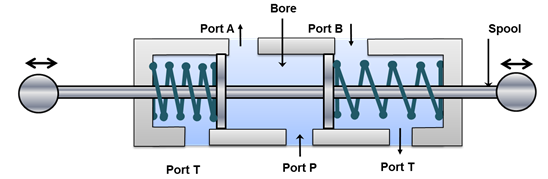
Figure 5.5.2 Three position four way valve: P to A and B to T
Figure 5.5.3 shows a three position four way valve in the closed center position. The working of the valve is similar to open center DCV. In closed center DCV all user ports (port A and port B) are closed. Therefore, these ports are hydraulically locked and the actuator cannot be moved by the external load. The pumped fluid flows through the relief valve. The pump works under the high pressure condition which not only wastes the pump power but also causes wear of the pump parts. The fluid temperature also rises due to heat generation by the pump energy transformation. The increase in fluid temperature may lead to the oxidation and viscosity drop of the fluid. The oxidation and viscosity drop reduces the pump life and leakage in the system.
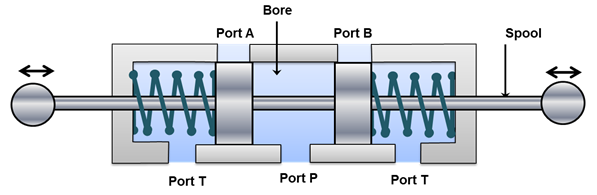
Figure 5.5.3 Three position four way valve: closed center