1.2 Number of ports
1.2.1 Two way valves
Two way valves have only two ports as shown in Figure 5.4.5 and Figure 5.4.6 . These valves are also known as on-off valves because they allow the fluid flow only in direction. Normally, the valve is closed. These valves are available as normally open and normally closed function. These are the simplest type of spool valves. When actuating force is not applied to the right, the port P is not connected with port A as shown in figure 5.4.5. Therefore, the actuation does not take place. Similarly, Figure 5.4.6 shows the two-way spool valve in the open condition. Here, the pressure port P is connected with the actuator port A.
1.2.2 Three way valves
When a valve has one pressure port, one tank port and one actuating port as shown in Figures 5.4.7 and 5.4.8, it is known as three way valve. In this valve, the pressure port pressurizes one port and exhausts another one. As shown in figures, only one actuator port is opened at a time. In some cases a neutral position is also available when both the ports are blocked. Generally, these valves are used to operate single acting cylinders.
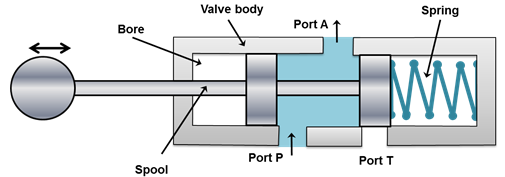
Figure 5.4.7 Three way valve: P to A connected and T is blocked
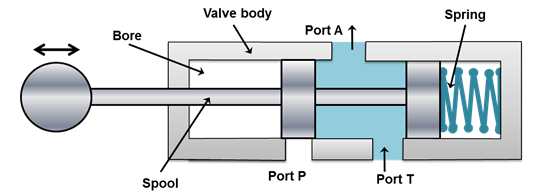
Figure 5.4.8 Three way valve in closed position
1.2.3 Four way valves
Figure 5.4.9 shows a four-way valve. It is generally used to operate the cylinders and fluid motors in both the directions. The four ways are: pump port P, tank port T, and two working ports A and B connected to the actuator. The primary function of a four way valve is to pressurize and exhaust two working ports A and B alternatively.
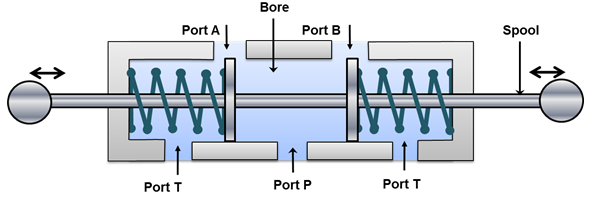
Figure 5.4.9 Three position four way valve in open center mode