2.2 Lobe Pump
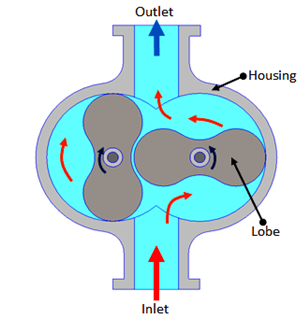
Figure 5.2.3 Lobe pump
Lobe pumps work on the similar principle of working as that of external gear pumps. However in Lobe pumps, the lobes do not make any contact like external gear pump (see Figure 5.2.3). Lobe contact is prevented by external timing gears located in the gearbox. Similar to the external gear pump, the lobes rotate to create expanding volume at the inlet. Now, the fluid flows into the cavity and is trapped by the lobes. Fluid travels around the interior of casing in the pockets between the lobes and the casing. Finally, the meshing of the lobes forces liquid to pass through the outlet port. The bearings are placed out of the pumped liquid. Therefore the pressure is limited by the bearing location and shaft deflection.
Because of superb sanitary qualities, high efficiency, reliability, corrosion resistance and good clean-in-place and steam-in-place (CIP/SIP) characteristics, Lobe pumps are widely used in industries such as pulp and paper, chemical, food, beverage, pharmaceutical and biotechnology etc. These pumps can handle solids (e.g., cherries and olives), slurries, pastes, and a variety of liquids. A gentle pumping action minimizes product degradation. They also offer continuous and intermittent reversible flows. Flow is relatively independent of changes in process pressure and therefore, the output is constant and continuous.
Lobe pumps are frequently used in food applications because they handle solids without damaging the product. Large sized particles can be pumped much effectively than in other positive displacement types. As the lobes do not make any direct contact therefore, the clearance is not as close as in other Positive displacement pumps. This specific design of pump makes it suitable to handle low viscosity fluids with diminished performance. Loading characteristics are not as good as other designs, and suction ability is low. High-viscosity liquids require reduced speeds to achieve satisfactory performance. The reduction in speed can be 25% or more in case of high viscosity fluid.