5.3 Preloading
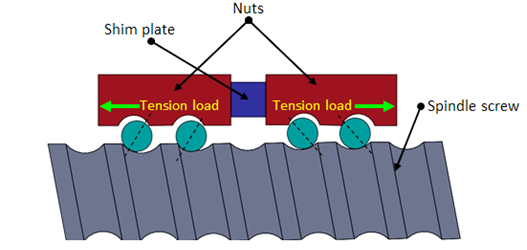
Fig. 4.4.3 Double nut preloading system
In order to obtain bidirectional motion of the carriage without any positional error, the backlash between the nut and screw should be minimum. Zero backlash can be obtained by fitting two nuts with preloading (tension or compression) or by applying a load which exceeds the maximum operating load. Figure 4.4.3 shows double nut preloading system. A shim plate (spacer) is inserted between two nuts for preloading. Preload is to create elastic deformations (deflections) in steel balls and ball grooves in the nut and the screw shaft in advance by providing an axial load. As a result the balls in one of the nuts contact the one side of the thread and balls in the other nut contact the opposite side.
5.3.1 Effects of preload
- Zero backlash: It eliminates axial play between a screw shaft and a ball nut.
- It minimizes elastic deformation caused by external force, thus the rigidity enhances.
In case mounting errors, misalignment between the screw shaft and the nut may occur this further generates distortion forces. This could lead to the problems such as,
- Shortened service life
- Adverse effect on smooth operation
- Reduced positioning accuracy
- Generation of noise or vibration
- Breakage of screw shaft
5.4 Advantages of ball screws
- Highly efficient and reliable.
- Less starting torque.
- Lower co efficient of friction compared to sliding type screws and run at cooler temperatures
- Power transmission efficiency is very high and is of the order of 95 %.
- Could be easily preloaded to eliminate backlash.
- The friction force is virtually independent of the travel velocity and the friction at rest is very small; consequently, the stick-slip phenomenon is practically absent, ensuring uniformity of motion.
- Has longer thread life hence need to be replaced less frequently.
- Ball screws are well -suited to high through output, high speed applications or those with continuous or long cycle times.
- Smooth movement over full range of travel.
5.5 Disadvantages of ball screws
- Tend to vibrate.
- Require periodic overhauling to maintain their efficiency.
- Inclusion of dirt or foreign particles reduces the life of the screws.
- Not as stiff as other power screws, thus deflection and critical speed can cause difficulties.
- They are not self-locking screws hence cannot be used in holding devices such as vices.
- Require high levels of lubrication.
5.6 Applications of ball screws:
- Ball screws are employed in cutting machines, such as machining center and NC lathe where accurate positioning of the table is desired
- Used in the equipments such as lithographic equipment or inspection apparatus where precise positioning is vital
- High precision ball screws are used in steppers for semiconductor manufacturing industries for precision assembly of micro parts.
- Used in robotics application where precision positioning is needed.
- Used in medical examination equipments since they are highly accurate and provide smooth motion.