5. Ballscrew based linear drives
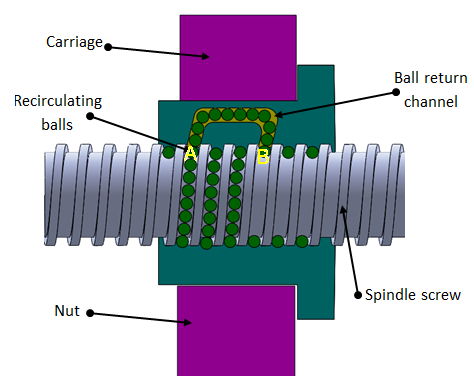
Fig.4.4.1 Ballscrew configuration
Ball screw is also called as ball bearing screw or recirculating ballscrew. It consists of a screw spindle, a nut, balls and integrated ball return mechanism a shown in Figure 4.4.1. The flanged nut is attached to the moving part of CNC machine tool. As the screw rotates, the nut translates the moving part along the guide ways. However, since the groove in the ball screw is helical, its steel balls roll along the helical groove, and, then, they may go out of the ball nut unless they are arrested at a certain spot. Thus, it is necessary to change their path after they have reached a certain spot by guiding them, one after another, back to their “starting point” (formation of a recirculation path). The recirculation parts play that role. When the screw shaft is rotating, as shown in Figure 4.4.1, a steel ball at point (A) travels 3 turns of screw groove, rolling along the grooves of the screw shaft and the ball nut, and eventually reaches point (B). Then, the ball is forced to change its pathway at the tip of the tube, passing back through the tube, until it finally returns to point (A). Whenever the nut strokes on the screw shaft, the balls repeat the same recirculation inside the return tube.
When debris or foreign matter enter the inside of the nut, it could affect smoothness in operation or cause premature wearing, either of which could adversely affect the ball screw's functions. To prevent such things from occurring, seals are provided to keep contaminants out. There are various types of seals viz. plastic seal or brush type of seal used in ball-screw drives.
5.1 Characteristics of ball screws:
5.1.1 High mechanical efficiency
In ball screws, about 90% or more of the force used to rotate the screw shaft can be converted to the force to move the ball nut. Since friction loss is extremely low, the amount of force used to rotate the screw shaft is as low as one third of that needed for the acme thread lead screw.
5.1.2 Low in wear
Because of rolling contact, wear is less than that of sliding contact. Thus, the accuracy is high. Ball screws move smoothly enough under very slow speed. They run smoothly even under a load.
5.1.3 Thread Form
The thread form used in these screws can either be gothic arc type (fig. 4.4.2.a) or circular arc type (fig. 4.4.2.b). The friction in this kind of arrangement is of rolling type. This reduces its wear as comparison with conventional sliding friction screws drives.
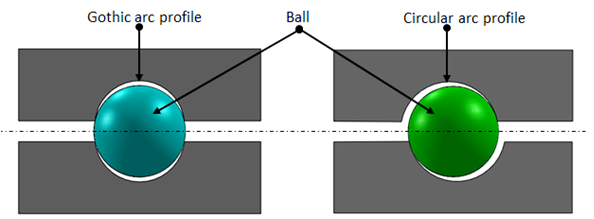
Fig. 4.4.2 Thread forms (a) Gothic arc (b) Circular arc
Recirculating ball screws are of two types. In one arrangement the balls are returned using an external tube. In the other arrangement the balls are returned to the start of the thread in the nut through a channel inside the nut.