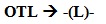
This is called as ‘output latch'. This instruction functions similar to output energize except that once a bit is set with OTL, it is latched on. Once an OTL bit has been set ON (1 on the memory) it will remain ON even if the rung condition goes false. The bit must be reset.
(U)
This is called as ‘output unlatch’. This is used to unlatch (reset) a latched bit. Its address must be same as latched one.
Timer
This is also called as “TON”. Figure 3.3.3 shows the schematic of a Timer. It is used to turn an output ON or OFF after the timer has been ON for preset time interval. This output instruction begins timing when rung goes true. It waits the specified amount of time (As specified in Preset), keeps track of accumulated intervals which have occurred (ACCUM), and sets DN (Done) bit when ACCUM time equals preset time.
As long as rung condition remains true, Timer adjusts its accumulated value to each evaluation until it reaches the preset value. The accumulated value is reset when rung condition go false, regardless of whether timer has timed out. ” TIME BASE” is an amount of time after which accumulator increases its value by 1.
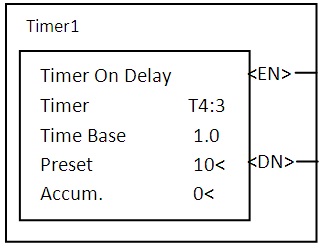 |
Figure 3.3.3 Schematic of a Timer |