1. Introduction
Any computer having input and output interfaces can be used to control external devices. However most of the computers are not industrially hardened. Input / Output devices of general-purpose microcomputers are not engineered to handle line-voltages and currents above transistor-transistor logic (TTL) levels. Also they are not designed to with-stand the temperature, humidity, and vibration on shop floors. These drawbacks of a general purpose computer have been rectified by developing a Programmable Logic Controller (PLC) with built-in isolation into their inputs and outputs.
“The programmable logic controller is defined as a digital electronic device that uses a programmable memory to store instructions and to implement functions such as logic, sequencing, timing, counting and arithmetic words to control machines and processes.”
PLCs are generally used for incorporating automation in open loop systems where processes are to be performed in a sequential manner. PLCs are used for automation of assembly lines in industries. They are generally designed for multiple input multiple output (MIMO) systems. In PLCs, instructions are saved in nonvolatile memory. Some of the advantages of PLCs are:
- Cost effective
- Flexibility and ability to use similar system for other processes
- Programming interface is easier in comparison to other processers
- Resistant to impact and vibration
- Resistant towards electrical and mechanical noise
- Ability to work at high temperatures
Now let us study the structure and functioning of a PLC.
2. Programmable Logic Controller: Structure and Functioning
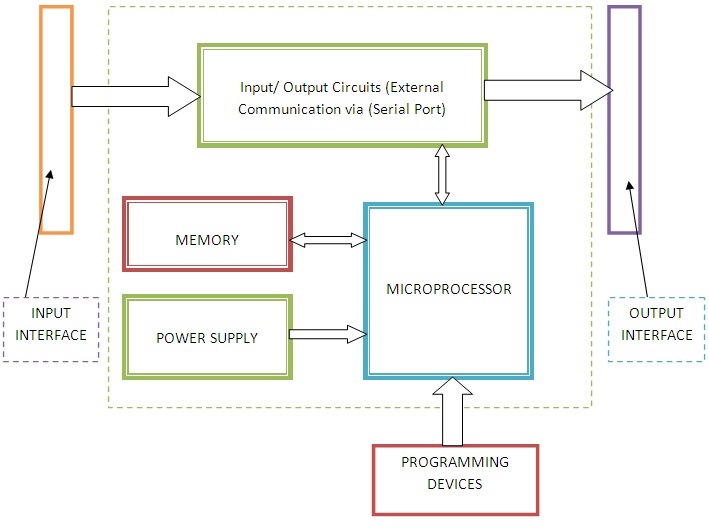 |
Figure 3.3.1 Block diagram of a PLC |