40.3 Temperature measurement using Thermocouple:
The most modern method of temperature measurement and control is using an electric circuit called as Thermocouple. Thermocouples made of two dissimilar metal conductors. These two conductors are joined at one junction while other junction is used to measure temperature. The output of the thermocouple circuit is Voltage and there is a specific relation between temperature and voltage.
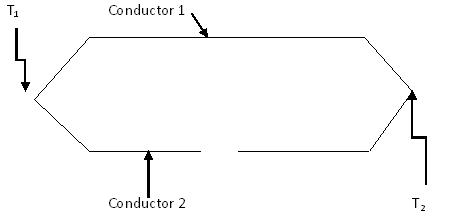
The junction 1 is at temperate T1 and junction 2 is at teperature T2. If T1, T2 are not equal, a finite electrical potential is generated between two junction. The thermocouple junction is the source of emf which gives rise to the potential difference. In thermocouple circuit when conductors are subjected to the temperature gradiant, flow of thermal as well as electric energy takes places. The characteristic behavior of the free electrons in an electric circuit is useful relationship between temperature and emf.
There are three basic phenomenon that can occure in thermocoupe cuircuit:
- The Seebeck Effect:
Seeback effect reffers to the generation of voltage potential or emf in an open thermocouple circuit due to temperature difference between two junctions of circuit. - The Peltier Effect
When a current is made to flow through the juction of two dissimilar metals, heat is generated at the higher temperature junction and absorbed at the lower temperature junction.
- The Thomson Effect
Consider a conductor which is subjected to the longitudinal temperature gradient and also to the potential difference such that there is a flow of current and heat in conductor. Therefore to maintain a constant temperature in the conductor it is found that a quantity of energy difference than Joule heat, I2R, must be removed from conductor.
FUNDAMENTAL THERMOCOUPLE LAWS:-- Law of Homogeneous Materials: - A thermoelectric current cannot be sustained in a single homogeneous material by the application heat alone, regardless of how it might vary in cross-section.
- Law of Intermediate Material: - The algebraic sum of thermoelectric forces in circuit composed of any number of dissimilar materials is Zero if all of the circuit is at same temperature.
- Law of Successive or Intermediate Temperature:- If two dissimilar homogeneous materials produces thermal (emf)1 when the junctions are T1 and T2 and produces thermal (emf)2 when the junction are at T2 and T3 the emf generated when the junction are at temperature T1 and T3 will be (emf)1 + (emf)2.
Depending on the combination of materials used for the conductors, thermocouples are classified in different types. The selection of the material is based on cost, availability, convenience, melting point, chemical properties, stability, and output. They are usually selected based on the temperature range and sensitivity needed.