40.1 Planar Laser Induced Fluorescence (PLIF)
Optical techiques are considered for flow visualisation, Planar Laser Induced Fluorescence (PLIF) is among such methods. This lased based technique is popular due to its abilities like remote controlling, precise prediction and non-intrusive. In this technique, a laser sheet is used to illuminate the flow and captures the fluorescence. Radicals which are most active species on the flow are chosen to track in this technique using the laser sheet to excite the species and hence to emitte the fluorescence which is captured on charge-coupled device (ICCD) camera .
A basic arrangement of PLIF is illustrated below in Fig 40.1. Consider a burner whose fluorescence is expected to capture. Therefore a laser beam passes through a cylindrical lens to convert it into a thin laser sheet. This laser sheet passes through the flame produced by a flat flame burner and excites the OH radical which inturn causes fluorescence. This fluorescence signal is then acquired in the camera in the form of the images. The images captured in the ICCD can be further considered for processing.
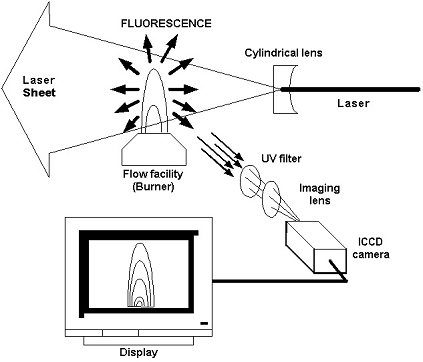
Fig 40.1 Basic Arrangement of PLIF
Disadvantages of PLIF: The major disdvantage is the quenchhing of the fluorescence at high pressure conditions due to high number of collisions of the molecules.
[Ref: Takashi Yokomae ,Report On “Planar Laser-Induced Fluorescence (PLIF) of H2 – O2 Combustion” ,The University Of Texas At Arlington, August 2003]
40.2 Pressure Measurements.
40.2 Pressure Transducers
Pressure measurement is generally performed using pressure transducers. These transducers are electro-mechanical devices used to convert pressure in to electrical signals which are recordable in any data acqusition system. Typical pressure transducer has an internal cavity which is divided into two parts by a metallic diaphragm. The pressure whcih is to be measured gets exposed to one side of this diagram however the other side of the diaphragm is kept at a reference pressure. The resulting differentail pressure provides bending of the diagram. The strain incurred by this bending thus proportioanl with the applied pressure. Pressure transducers having advantages over conventional devices like manometer as they provide a signal which can be recorded and used for processing, minature size transducers can be mounted anywhere in the tunnel, transducers respond quickly with change in the dynamics of the flowfield etc.
40.3 Pressure-sensitive paint (PSP)
Use of PSP is also a method for measuring air pressure. These paints are applied on the surface of the object over which pressure is to be measured. These paints create fluoresces of different intensities for different pressures. Use of PSP being non-intrusive technique has gained attention in the research community. Accuracy of measurement based on PSP is solely dependant on luminescence created. A typical PSP system is comprised of a PSP, an illumination source, a detector, and a long-pass filter. The PSP is applied over the test model surface and the surface is then illuminated by the excitation source causing the PSP to luminesce. A typical paint employed for these measurements is comprised of two main parts, an oxygen-sensitive fluorescent molecule and an oxygen-permeable binder. During the experiment, luminescent molecule absorbs a photon and gets excited to an higher energy level. The same molecule while returning to the ground state emittes photon of a longer wavelength. Pressure sensitivity of this molecules can be seen when such molecule interacts with an oxygen molecule and transfers its energy to ibration mode of the oxygen molecule. The resulting transition to the ground state does not emitte any photon. This process is called as oxygen quenching. Amount of oxygen governs the rate of this process. The luminescent intensity from the PSP is recorded in the detector and can be converted to pressure using the calibration chart.