39.3 Schlieren Technique
The Schlieren method is one more technique prevalently used for visualizing the compressible flow due to presence of large density gradients. Schematic diagram of a typical Schlieren arrangement used for supersonic flow visualization is shown in Fig. 39.2.
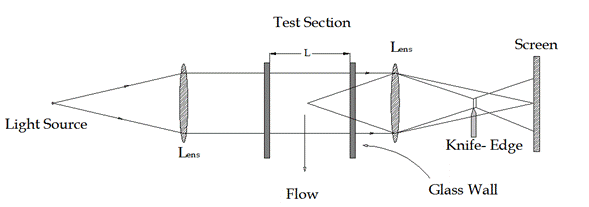
Fig. 39.2 Schematic of Schlieren arrangement
This techniques also uses a light source and lens where Light emitted from the source is collimated by the lens before passing through the test section. These light beams are then passed through one more lens before getting on the screen. A knife edge is placed at the focal point of the second lens where the images of the source is formed. Kinfe endge can be any opaque object which can be placed at the same location. This object or knife object is obstrcut the light beam. If the beams of light escape the knife edge the screen gets uniformly illumination. This situation is seen for no flow case through the test section since both the beams pass though the medium of same density. However during the flow taking place in the test section with test model mounted in it, both the light beams encounter different densities therefore make different deflections one of the beams pass through uniform or freestream density region while other beam passes through the portion of shock placed ahead the test model. in this way one beam passes through a region of uniform density while other passes through differential density regions or sees the density gradient. It is similar to the light beam passing through a prism when that ray of light bends. This is the reason for orientation of the knife edge for the known density gradient since the ray of light which encounters the density gradient creates differential illumination on the screen presence of knife edge. In this way Schlieren technique makes it possible to visualise density gradient by differential illuminations on the screen. A photographic plate or camera are generally used for viewing instead of screen.
The major requirement for the Schlieren imaging is to have high optical quality lenses and with large diameter and long focal length. The need for large diameter is necessiate that the coverage of entire flow field. The demand for larger focal length is to acquire proper images on the screem. The quality of the lenses should also be higher in order to avoid chromatic and spherical aberrations and lessen the astigmatism.
It has been observed that is difficult to visualise images using this technique for very large cross section wind tunnels due to unavailability of high optical quality and diameter of lenses. The cost of such lenses is the major conern is such cases. Use of concave mirroes is the immediate remedy on such situations. This is due to the fact that these lenses are easy to fabricate and also to correct during the experimental setting. The minimum optical quality is implicit in these lenses. The Schlieren arrangement with such low cost lenses is as shown in Fig 39.3.
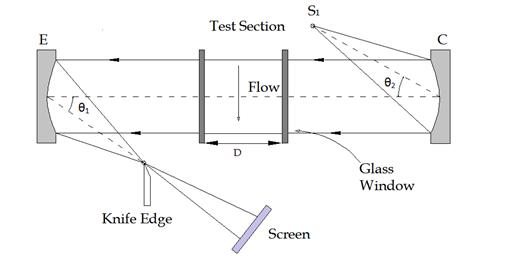
Fig. 39.3. Schematic of twin Schlieren arrangement