30. 1 Introduction
The flow over a cone is a two-dimensional axisymmetric problem. It is also referred to as “Quasi-Two dimensional Problem”. This is so, because, the cone under consideration is aligned symmetrically about the z-axis or along the direction of  , as shown in the Fig.30.1
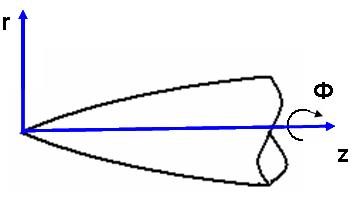
Fig. 30.1: Geometry in consideration and the fluid flow direction
The supersonic flow over a cone is of great practical importance in applied aerodynamics. The nose cones of many high-speed missiles and projectiles are approximately conical, are the nose regions of the fuselages of most supersonic airplanes.
In the particular problem of supersonic flow over a cone, consideration is given to a sharp right circular cone with zero angle of attack. Consider a cone on the  co-ordinate system, as shown in Fig. 30.1 which is symmetric about the Z axis and extends to infinity with a semi-vertex cone angle θ. The supersonic flow with freestream velocity is considered along the Z axis, such that the angle of attack is 0o.
Tytpical flowfield for supersonic flow over cone is as shown in Fig. 30.2. For such a supersonic flow over the surface of the cone, it is expected that a oblique shock wave attached to the tip of the cone is formed. Further, the shape of the shock wave formed is also conical. A streamline from the supersonic freestream discontinuously deflects as it passes through the shock, and then curves continuously downstream of the shock, becoming parallel to the cone surface asymptotically at infinity. Further, it is also assumed that the pressure and all the other flow properties are constant along the surface of the cone. Since the cone surface is simply a ray from the vertex, consider other such rays between the cone surface and the shock wave, as shown by the dashed line in Fig 30.2. Hence assumption of constacny of flow properties can be extended along these rays as well. therefore properties variation takes place as the fluid moves from one ray to the next.
co-ordinate system, as shown in Fig. 30.1 which is symmetric about the Z axis and extends to infinity with a semi-vertex cone angle θ. The supersonic flow with freestream velocity is considered along the Z axis, such that the angle of attack is 0o.
Tytpical flowfield for supersonic flow over cone is as shown in Fig. 30.2. For such a supersonic flow over the surface of the cone, it is expected that a oblique shock wave attached to the tip of the cone is formed. Further, the shape of the shock wave formed is also conical. A streamline from the supersonic freestream discontinuously deflects as it passes through the shock, and then curves continuously downstream of the shock, becoming parallel to the cone surface asymptotically at infinity. Further, it is also assumed that the pressure and all the other flow properties are constant along the surface of the cone. Since the cone surface is simply a ray from the vertex, consider other such rays between the cone surface and the shock wave, as shown by the dashed line in Fig 30.2. Hence assumption of constacny of flow properties can be extended along these rays as well. therefore properties variation takes place as the fluid moves from one ray to the next.
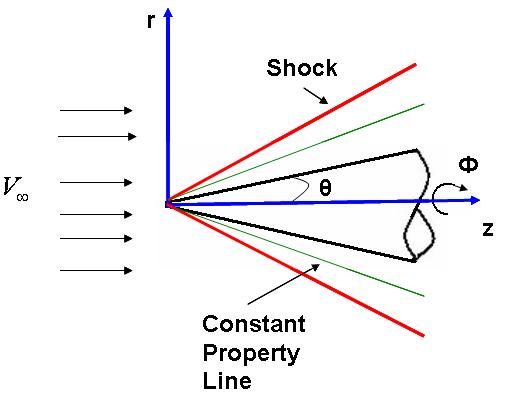
Fig.30.2: Flowfield in the presence of supersonic flow over a cone.