25.1. Prandtl Meyer Function
We can see that since for positive value of dθ, we get positive dV which leads to expansion. This formula is also valid for small angles for compression where we get negetive dV. If we integrate this formula for the toal expansion angle then we can get the downstream Mach number.
|
25.4 |
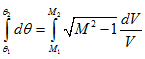
Before integrating we can express the integrant in Mach number,
V = Ma
ln V = ln M + ln a
|
25.5 |
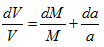
We can express here the second term on right hand side in terms of Mach number using the isentropic relations as,
|
25.6 |
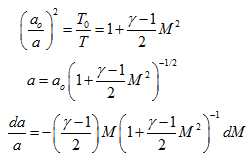
Using Eq. (25.5) and (25.6) we can re-write Eq. (25.4) as,
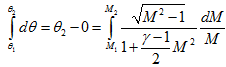
Intergration of right hand side is as,

Here, v is called as the Prandtl-Meyer function.
θ = v(M2) - v(M1) |
25.7 |
Therefore upstream Mach number (M1) we can calculate the upstream Prandtl-Meyer function. Hence for known flow deflection angle and upstream Mach number we can get the downstream Prandtl-Meyer function and hence the downstream Mach number.
Process of expansion of supersonic flow is an isentropic process. However, while passing through the expansion fan, pressure, temperature and density of the flow decreases while Mach number and velocity increases for the supersonic flow. Moreover, all the total properties remain constant. We can calculate the total pressure, temperature and density upstream of the expansion using isentropic relations for the known flow Mach number. From the calculated downstream Mach number, we can calculate all the static flow properties from known stagnation or total properties.