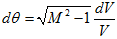
25.1. Expansion Fan
We have already seen that compression of supersonic flow takes while passing through the shock. In other words, when the supersonic flow turns into itself then it undergoes the compression through a shock. Exactly opposite situation can be encountered when the supersonic flow tuns out of itself where, expansion of the supersonic flow takes place. This expansion unlike compression takes place smoothly through infinite expansion waves hence called as expansion fan. This expansion fan is comprised of infinte number of expansion waves or Mach waves where every wave is responsible for infinitesimal amount of delfection. iTypical expansion fan in the supersonic flow is shown in Fig. 25.1. where supersonic flow tuns outward by an angle θ.
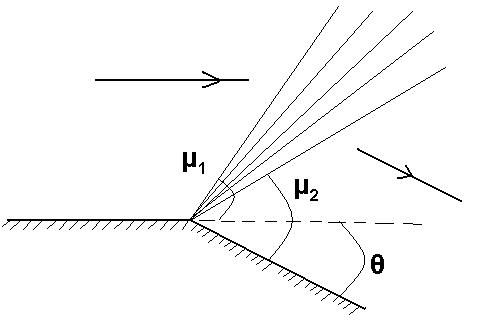
Fig. 25.1 Expansion of supersonic flow
For better understanding of expansion of supersonic flow, consider that p1, T1 and M1 be the properties of flow before expansion or upstream of the expansion fan and p2, T2 and M2 be the properties of the flow after expansion or downstream of the expansion fan due to outward deflection by an angle θ. For the know upstream flow properties and deflection angle it should be possible for us to calculate the downstream flow properties. Since the expansion is the continuous and smooth process carried out via infinite Mach waves, lets consider one such wave across upstream of which velocity is V and Mach number is M. Angle made by this Mach wave with the upstream velocity vector is μ. Lets consider dV be the change in velocity brought by the Mach wave by turning through an angle dθ. Hence V+dV is downstream velcoity and M+dM is the downstream Mach number. If we construct the velocity triangle as shown in Fig. 25.2 then we can use the sin law for traingle as,
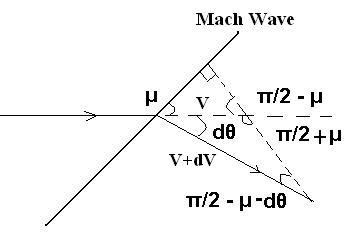
Fig. 25.2 Velocity triangle across a typical Mach wave during supersonic expansion
|
|
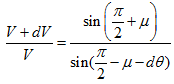
But we know that
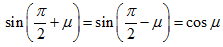
and

Hence we can re-write Eq. (25.1) as,
|
25.2 |
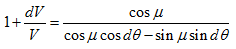
We can approximate as
sin dθ ≈ dθ and cos dθ ≈ 1, Therefore Eq. (25.2) can be simplified as,
|
25.3 |
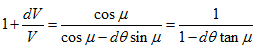
since dθ tan μ < 1, lets recall the expansion for x<1,
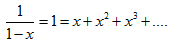
Neglecting higher order term, we can express Eq. (25.3) as,
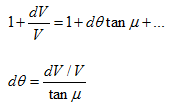
But we know that
 and hence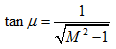
Hence above equation becomes,