b.Corner of the base on HP with two base edges containing the corner on which it rests make equal inclinations with HP
When a solid lies on one of its corners of the base on HP, then the two edges of the base containing the corner on which it lies make either equal inclinations or different inclination with HP. Initially the solid should be placed with its base on HP such that an imaginary line connecting the center of the base and one of its corners is parallel to VP, i.e. to XY line in the top view, and preferably to lie on the right side. For example, when a hexagonal prism has to be placed with a corner of the base on HP such that the base or the axis is inclined to HP, then initially the prism is placed with its base on HP such that an imaginary line connecting the center of the base and a corner is parallel to VP and it lies on the right side. In this position, the first set of top and front views are drawn , as shown in step-1 of figure 2 . The line (o1)(d1) is parallel to the XY line in the top view.
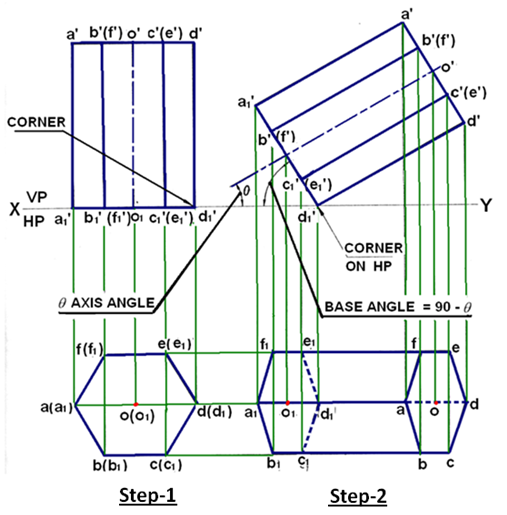
Figure 2: Projections of a prism with a corner of the base on HP and the axis is inclined to HP.
Since the prism has to lie on one of its corners of the base on HP, the front view of the prism is tilted on the corner d1’ such that the axis is inclined at q to HP. Redraw the front view in the tilted position as shown in Step-2 of figure-2. The base edge is drawn at (90- θ) in the front view. The second top view is projected by drawing the vertical projectors from the corners of the second front view and horizontal projectors from the first top view.