Vernier Scale
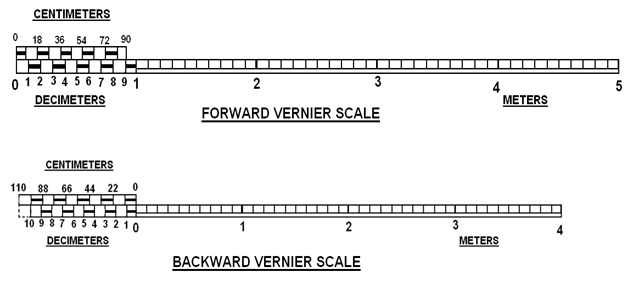
- Similar to Diagonal scale, Vernier scale is used for measuring up to second decimal.
- A Vernier scale consists of (i) a main scale and (ii) a vernier.
- The main scale is a plain scale fully divided in to minor divisions. A subdivision on the mail scale is called the main scale division (MSD) .
- The graduations on the vernier are derived from those on the primary scale. A subdivision on the verscale is called the vernier scale division (VSD).
Least Count (LC) is the minimum length that can be measured precisely by a given vernier scale. This can be determined by the following expression:
LC = MSD – VSD ( if MSD > VSD)
LC = VSD – MSD ( if VSD > MSD)
The LC is mentioned as a fraction of the MSD.
If the MSD of a scale represents 1 mm and LC is 0.1 mm,
LC = 0.1 mm = (1/10) MSD
- Assume MSD > VSD
LC = MSD –VSD
1/10 MSD = MSD –VSD
i.e., VSD = MSD – 1/10 MSD
10 VSD = 9 MSD
i.e., Length of VSD = 9 MSD.
- Assume VSD > MSD
LC = VSD – MSD
1/10 MSD = VSD – MSD
i.e., VSD = 1/10 MSD + MSD
10 VSD = 11 MSD
This length is to be divided in to 20 equal parts so that LC = 0.1 mm
This length must be divided in to 10 equal parts so that LC = 0.1 mm