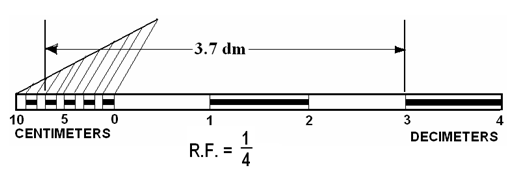
Construct a plain scale of RF = 1:4, to show centimeters and long enough to measure up to 5 decimeters.
- R.F. = ¼
- Length of the scale = R.F. × max. length = ¼ × 5 dm = 12.5 cm.
- Draw a line 12.5 cm long and divide it in to 5 equal divisions, each representing 1 dm.
- Mark 0 at the end of the first division and 1, 2, 3 and 4 at the end of each subsequent division to its right.
- Divide the first division into 10 equal sub-divisions, each representing 1 cm.
- Mark cm to the left of 0 as shown.
- Draw the scale as a rectangle of small width (about 3 mm) instead of only a line.
- Draw the division lines showing decimeters throughout the width of the scale.
- Draw thick and dark horizontal lines in the middle of all alternate divisions and sub-divisions.
- Below the scale, print DECIMETERS on the right hand side, CENTIMERTERS on the left hand side, and R.F. in the middle.
Diagonal Scale :-
- Through Diagonal scale, measurements can be up to second decimal places (e.g. 4.35).
- Are used to measure distances in a unit and its immediate two subdivisions; e.g. dm, cm & mm, or yard, foot & inch.
- Diagonal scale can measure more accurately than the plain scale.
Diagonal scale…..Concept
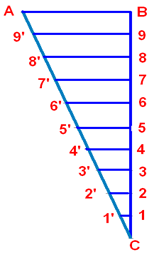
- At end B of line AB, draw a perpendicular.
- Step-off ten equal divisions of any length along the perpendicular starting from B and ending at C.
- Number the division points 9,8,7,…..1.
- Join A with C.
- Through the points 1, 2, 3, etc., draw lines parallel to AB and cutting AC at 1΄, 2΄, 3΄, etc.
- Since the triangles are similar; 1΄1 = 0.1 AB, 2΄2 = 0.2AB, …. 9΄9 = 0.9AB.
- Gives divisions of a given short line AB in multiples of 1/10 its length, e.g. 0.1AB, 0.2AB, 0.3AB, etc.