Chemical Exergy
A system is in thermal and mechanical equilibrium with the environment when the system attains the dead state. Under such conditions, exergy of the system is zero. However, the contents of a system even at the dead state may undergo chemical reaction with environmental components and produce additional work.
Consider a combined system formed by an environment and a system having a certain amount of fuel at T0, p0 Work is obtainable by allowing the fuel to react with oxygen from the environment to produce the components of CO2 and H2O. The chemical exergy is thus defined as the maximum theoretical work that could be developed by the combined CO2 system. Thus for a given system at a specific state
Total exergy = Thermomechanical exergy + Chemical exergy
Let us consider a hydrocarbon fuel (CaHb) at T0, p0 reacting with oxygen from the environment (Fig.3.7) which is assumed to be consisting of an ideal gas mixture at T0, p0.
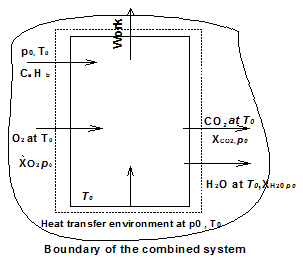
Fig. 3.7 Fuel exergy concept
The oxygen that reacts with the fuel is at a partial pressure of  , p0 where
  is the mole fraction of oxygen in the environment. The fuel and oxygen react completely to produce CO2 and H2O, which exit in separate steams at
  and respective partial pressures of
 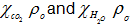 . The reaction is given by
|
(3.123) |

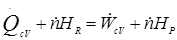
At steady state, the energy balance gives
|
(3.124) |
or,
|
(3.125) |

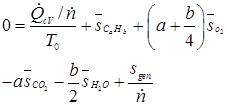
where  is the rate of fuel flow in moles, and K.E. and P.E. effects are neglected. An entropy balance for the control volume gives
|
(3.126) |