Absolute Entropy and the Third Law of Thermodynamics
So far only first law aspects of chemical reactions have been discussed. The second law analysis of chemical reactions needs a base for the entropy of various substances. The entropy of substances at the absolute zero of temperature, called absolute entropy, is dealt with by the third law of thermodynamics formulated in the early twentieth century primarily by Nernst (1864-1941) and Max Planck (1858-1947). The third law states that the entropy of a perfect crystal is zero at the absolute zero of temperature ant it represents the maximum degree of order. A substance not having a perfect crystalline structure and processing a degree of randomness such as a solid solution or a glassy solid has a finite value of entropy at absolute zero. The third law provides an absolute base from which the entropy of each substance can be measured. The entropy relative to this base is referred to as the absolute entropy. Table 3.5 gives the absolute entropy of various substances at the standard state 25° C, 1atm. For any other state,
|
(3.120) |
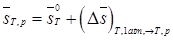
where  refers to the absolute entropy at 1 atm, and temperature T, and
  refers to the change of entropy for an isothermal change of pressure from 1atm to pressure p (Fig.3.6).
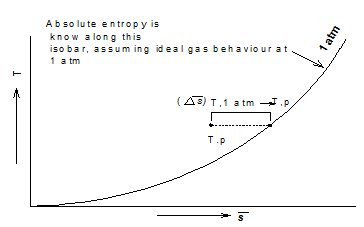
Fig. 3.6 Absolute entropy
Table 3.5 give the value of  for various substances at 1 atm. and at different temperatures. Assuming ideal gas behaviour
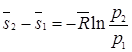
  can be determined (Fig 3.6).
|
(3.121) |
or,
|
(3.122) |
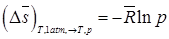


where p is in atm.
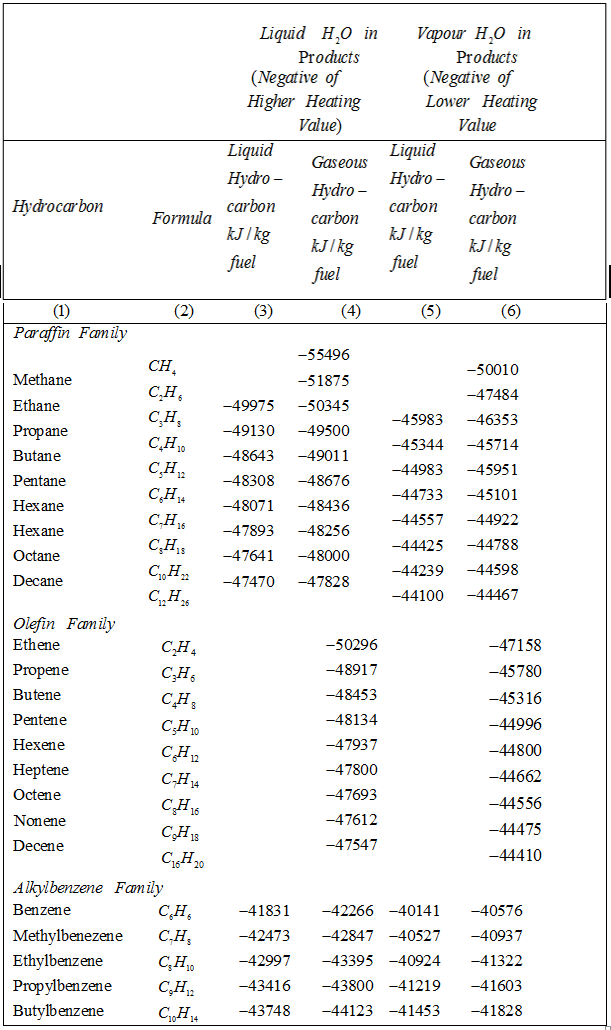
Table 3.6 Enthalpy of Combustion of Some Hydrocarbons at 25° C