It is seen that when n1 = n1(max), ε = 0, the reaction will start from left to right. When n1 = n1(min),ε = 1, reaction is complete from left to right.
The degree of reaction can thus be written in the form
|
(3.18) |
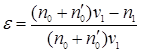
Therefore
|
(3.19) |

or,
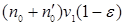
n1 = Number of moles of A1 at start - number of moles of A1 |
(3.20) |
|
(3.21) |
|
(3.22) |
|
(3.23) |
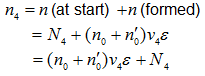
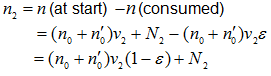
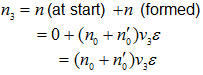
The number of moles of the constituents change during a chemical reaction, not independently but restricted by the above relations (Eqs. (3.20-3.23)). These equations are the equations of constraint. The n's are functions of ε only. In a homogeneous system, in a given reaction, the mole fraction x's is also function of ε only, as illustrated below.
Let us take the reaction
|
(3.24) |

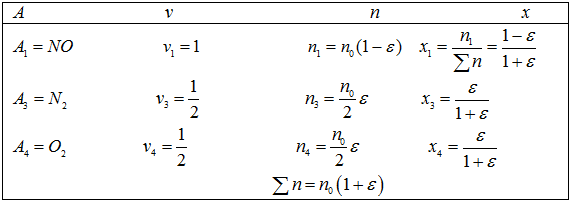
in which n0 moles of NO dissociates to produce  moles of N2 and
 moles of O2. The n's and x's as function of ε are shown in the Table-3.1 given below
Table 3.1 Values of v, n and x (Eq. (3.24))
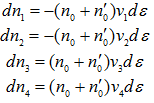
If the reaction is imagined to advanced to an infinitesimal extent, the degree of reaction changes from ε to ε + dε, and the various n's will change by the amounts (Upon differentiation of Eqs. (3.20-3.22) w.r.t. ε)
|
(3.25) |

which shows that the dn's are proportional to the v's.