where n0 is an arbitrary positive number, and N2 is the residue(or excess) of A2, i.e., the number of moles of A2 which cannot combine. If the reaction is assumed to proceed complete it to the left with the disappearance of the final constituent A3 then
|
(3.7) |
|
(3.8) |

where  is an arbitrary positive number and N4 is the excess number of moles of A4 left after the reaction is complete from right to left. For a reaction that occurred completely to the left, there is a maximum possible amount of each initial constituent, and a minimum possible amount of each final constituent, so that
|
(3.9) |

where n0v1 = Original number of moles of
 = Number of moles of formed by chemical reaction

|
(3.10) |

where (n0v1 + N2) = Original number of moles of
 = Number of moles of formed bychemical reaction
The constituent A3 completely disappears by reaction, hence
n3(min) = 0 |
(3.11) |
The excess number of moles of that are left after the reaction is complete to left
n4(min) = 0 |
(3.12) |
Similarly, if the reaction is imagined to proceed completely to the right, there is a minimum amount of each initial constituent, and a maximum amount of each final constituent, so that
n1(min) = 0 |
(3.13) |
n2 (min) = N2 |
(3.14) |
|
(3.15) |

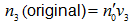
where  = original amount
n0v3 = amount formed by chemical reaction
(n0v1A1 + n0v2A2 → n0v3A3 + n0v4A4)
|
(3.16) |

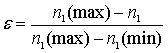
Let us suppose that the reaction proceeds partially either to the right or to the left to the extent that there are n1 moles of A1, n2 moles of A2, n3 moles of A3 and n4 moles of A4. The degree (or advancement) of reaction ε is defined in terms of any one of the initial constituents, say, A1 as the fraction
|
(3.17) |