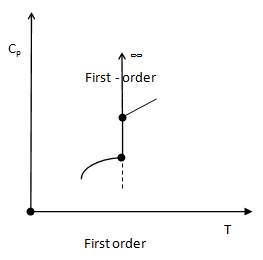
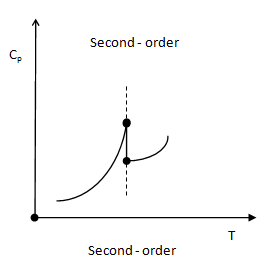
Variation of Cp for first and second order phase transition are given in Figs. 2.15 and 2.16.
|
|
Fig. 2.15 |
Fig.2.16 |
Properties of superfluid
Superfluids have the unique quality that their atoms are in the same quantum state. This means they all have the same momentum, and if one moves, they all move. This allows superfluids to move without friction through the tiniest of cracks, and superfluid helium will even flow up the sides of a jar and over the top. This apparant defiance of gravity comes from a special type of surface wave present in superfluid helium, which in effect pushes this extremely thin film up the sides of the container. It was discovered in 1962 by Tisza, who named the phenomenon third sound. Another unusual result of third sound is the fountain effect, where superfluid excited by photons will form a fountain vertically upward off of its surface.
Superfluids also have an amazingly high thermal conductivity. When heat is introduced to a normal system, it diffuses through the system slowly. In a superfluid, heat is transmitted so fast that thermal waves become possible. This fourth kind of wave found in superfluids is called second sound, quite improperly becuase they involve no pressure variations. Following are some of the remarkable properties of superfluid He II:
- Ability to flow through microscopic passages with no apparent friction
- The quantization of vortices
- The ability to support four wave modes:
- Sound which is analogous to sound in ordinary gases and liquids,
- Sound which carries temperature and entropy perturbations with virtually no pressure variations
- Sound which are waves on thin films
- Sound which are acoustic-like waves in the "superfluid" component of He II.
As in the case of both classical and high temperature superconductivity, superfluidity is a manifestation of quantum mechanical effects at the macroscopic level.
*** Helium He4 vapor compressed isothermally between 5.25 K to 2.18 K, condenses to liquid helium He l. When vapor is compressed below 2.18 K, a liquid called super fluid helium He ll results.