The zeroth law and third law are more definitional in nature. The first and the second laws are more pragmatic and as an engineer we use both these laws for analysis.
Zeroth law gives the definition of temperature.
This law was framed by Ralph Fowler and Guggenheim. Fowler was a British Physicist and astronomer. He named zeroth law of thermodynamics in 1920. Fifteen Fellows of the Royal Society and three Nobel Laureates were supervised by Fowler between 1922 and 1939. He worked with Sir Arthur Eddington, Subrahmanyan Chandrasekhar, Paul Dirac, Sir William McCrea and Milne. Fowler introduced Paul Dirac to quantum theory in 1923. He supervised the doctoral studies of 64 students at Cambridge University, including John Lennard-Jones, Paul Dirac and Garrett Birkhoff.
|
|
Ralph Fowler |
Edward Armand Guggenheim |
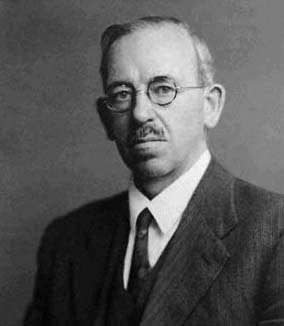
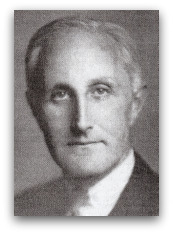
Fig: 1.8 Photo of Fowler and Guggenheim
Edward Armand Guggenheim (1901–1970) was an English thermodynamicist and professor of chemistry at the University of Reading in the year 1939, Guggenheim co-authored a volume entitled Statistical Thermodynamics with Ralph Fowler. The text book by Fowler and Guggenheim on Statistical Thermodynamics was published by Cambridge University Press in 1960.
Temperature is the only property which differentiates thermodymanics from other sciences. The first law is nothing but conservation of energy. Second law indicates the probability of happening of a cycle or process and indicates the direction of energy flow. Further, second law distinguishes the quality of energy. The third law gives the interpretation of a system while marching towards absolute zero temperature. Application of both the first and second law to a process give rise to some properties (internal energy and enthalpy from first law, entropy from the second law).