Module 9 : Forced Vibration with Harmonic Excitation; Undamped Systems and resonance; Viscously Damped Systems; Frequency Response Characteristics and Phase Lag; Systems with Base Excitation; Transmissibility and Vibration Isolation; Whirling of Shafts and Critical Speed.
Lecture 1 : Harmonic vibration of single DOF system
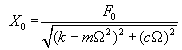
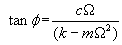
The first part of the response, corresponding to the complementary solution representing the free vibration response, is at the damped natural frequency of the system and decays very fast exponentially !. In practice every system has some form of dissipation or other and hence this will eventually die down (as we discussed in module 8. ) leaving only the “steady state” response pertaining to the particular integral. The steady state response is a sinusoid at the frequency of excitation (called forcing frequency or driving frequency) and has some phase difference with the excitation as depicted in Fig. 9.1.3 of special interest is the amplitude of steady state which can be obtained as follows.
Fig 9.1.3 Phase relation of excitation and response


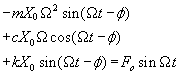

 and
 on either side we have