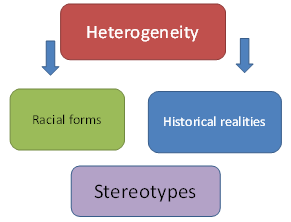
This is the shift we see once we move away from the biological discourse with which the articulation of race began: Cultural Studies shows us that issues and aspects of race are those that are articulated through representation. What was seen as something that could be marked physically on a person becomes one that is understood as signifiers. Even if there were essential biological-cultural differences, the problem happens only when we try to hierarchize these or render some of the characteristics and differences as being better or worse compared to others.
Within the discourses and realities of race we should be able to realize that the forms and realities of racism are different in different times and spaces. There are different historical realities that lead to this difference in these forms and realities. Therefore Barker says that the forms and realities of racism are not homogenous:
• “Forms and realities of racism are not homogenous
• Different historical realities
• British Asians are stereotyped as doctors and shopkeepers while young Afro-Caribbean men in Britain are cast in the role of criminals
• the “new racism” in Britain relies not on biological discourses of superiority, as in South African apartheid, but on cultural differences that exclude black people from being fully a part of the nation .”