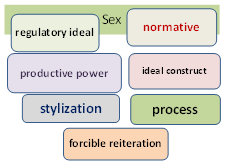
Sex too is shaped by and through discourse, repetition and reiteration. Instead of the earlier view of sex being a fixed biological (physical) identity, we find that sex and sexual practices are legitimized through the following:
Angela MacRobbie in The Uses of Cultural Studies (2005) assesses the importance of Butler's Gender Trouble : “ Butler makes trouble for feminism, querying the existence of its foundations and interrogating its various claims. Her writing inaugurates and confirms a significant, indeed seismic shift, for feminism… the appearance of Gender Trouble in 1990 … interrogat(ed) the stability and very existence of the category of woman which feminist politics has organised itself around.”
Similarly, Sarah Salih in Judith Butler (2002) holds that Gender Trouble makes trouble by “calling the category of ‘the subject' into question by arguing that it is a performative construct … asserting that there are ways of ‘doing' one's identity whichwill cause even further trouble for those who have a vested interest in preserving existing oppositions such as male/female, masculine/feminine, gay/straight and so on.”