| Breakdown with Stable Streamer Corona |
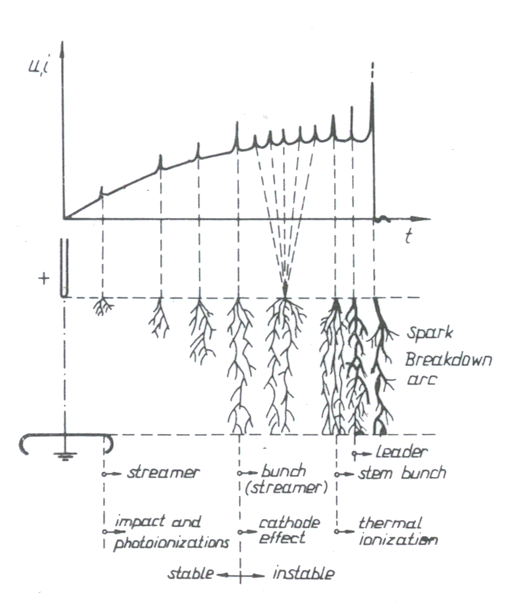
- As described in earlier lecture, when the basic requirement for the field intensity distribution in the gap is met, streamer or Kanal discharge, that is, avalanche with above critical amplification incept. On raising the applied voltage, these streamers propagate in the main field direction towards the opposite electrode, besides spreading in radial direction also as shown in Fig. 13.1(b). If the conditions required for the growth of streamer is met throughout the gap length, the discharge can extend upto the opposite electrode. It is at this stage that a stable streamer discharge is rendered instable. A schematic illustration of the development of breakdown mechanism with stable positive streamer discharge throughout the gap length is shown in Fig. 13.4.
|
|
Fig 13.4 Breakdown mechanism development with stable streamer discharge. |
- As soon as the streamer is able to extend itself upto the opposite electrode, say the cathode, more dense streamer discharge erupts from the anode because of 'cathode effect', also known as '
 -effect' or secondary process. The current density at the tip of the rod electrode increases considerably due to the conduction of charge carriers, leading to an excessive temperature rise. This causes thermal ionization in front of the tip of the electrode due to the constriction of streamer channels. Subsequently, first a short bright 'stem' and then a 'stembunch' discharge breaks out, turning into a thriving instable leader as shown in Fig. 13.4. Breakdown is accomplished with a 'final jump' of the leader bridging the two electrodes. Ultimately an arc is produced which conducts the short circuit current. This type of breakdown mechanism is primarily observed in medium gap lengths, say upto about 1 m, depending upon the electrode configuration and the type of applied voltage. All the three types of voltages, that is, ac, dc and si may produce breakdown with stable streamer. Since the total duration of li is very short , it is unable to produce a stable corona. -effect' or secondary process. The current density at the tip of the rod electrode increases considerably due to the conduction of charge carriers, leading to an excessive temperature rise. This causes thermal ionization in front of the tip of the electrode due to the constriction of streamer channels. Subsequently, first a short bright 'stem' and then a 'stembunch' discharge breaks out, turning into a thriving instable leader as shown in Fig. 13.4. Breakdown is accomplished with a 'final jump' of the leader bridging the two electrodes. Ultimately an arc is produced which conducts the short circuit current. This type of breakdown mechanism is primarily observed in medium gap lengths, say upto about 1 m, depending upon the electrode configuration and the type of applied voltage. All the three types of voltages, that is, ac, dc and si may produce breakdown with stable streamer. Since the total duration of li is very short , it is unable to produce a stable corona.
|
- An analytical explanation of the mechanism described above is difficult. However, a distinction between breakdown with stable and instable streamers can be made in terms of the degree of uniformity of the field.
|
Consider in fig 11.2, a breakdown when η is greater or equal to ηlim . The breakdown voltage for the region A can be estimated by Equation 13.1;
|
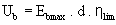 (13.1) (13.1) |
The breakdown voltage for the region B is given by the equation;
|
 (13.2) (13.2) |
where Es is the average potential gradient required for breakdown with stable streamer discharge or across the streamer channels which is about 4.5 kV/cm for positive polarity voltage. A round figure of 5 kV/cm is accepted in this case.
|
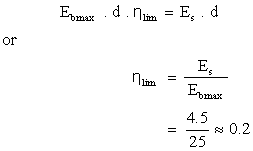
Equating the two equations given above and considering a value of 25 kV/cm for Eb max (the maximum breakdown field intensity for air in weakly nonuniform fields), the value of ηlim for atmospheric air can be determined as follows:
|
|
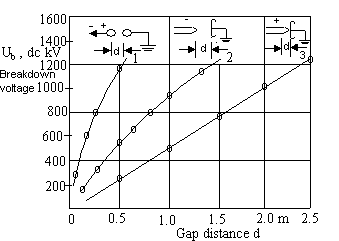
- Characteristics of breakdown with dc voltage for air gaps upto 2.5 m are shown in Fig. 13.5 with both positive and negative polarities for sphere-sphere and rod-plane electrode gaps. The curve number 1 for gaps between large size sphere-sphere configuration represents the weakly nonuniform field even upto 50 cm of gap distance. Since no partial breakdown takes place before the breakdown in this field, no effect of polarity is measured on the breakdown voltage. The curve number 2, measured with negative polarity voltage on a rod-plane gap, a case of extremely nonuniform field, is accompanied with stable negative streamer corona. The mean potential gradient requirement of about 10 kV/cm for negative streamer is observed to have met for this curve. The last curve, number 3, accompanied with stable positive streamer, represents an average potential gradient requirement of about 5 kV/cm in the gap.
|
|
Fig 13.5 dc breakdown voltage characteristic, with both polarities, for 'sphere-sphere' and rod-plane long air gap. |
- The development of different breakdown characteristics strongly suggest that the breakdown voltage magnitudes depend upon the type of stable partial breakdown that occur in the gap before the final jump. The breakdown voltage characteristic for a rod-plane gap (Fig. 13.6), on applying positive 60/2500 μs shape of impulse voltages, represented breakdown with stable streamer corona up to a relatively small gap distance of 1 m. The average potential gradient required for breakdown in this region was 4.5 kV/cm. On increasing the gap distance, a lower average potential gradient requirement for breakdown was measured continuously. Finally, an average potential gradient of 1 kV/cm was required for breakdown of the gaps above 4 m in this case. Stable leader corona could be observed for gap lengths above 2 m for the given electrode system. As illustrated in Fig. 13.6, the breakdown voltage characteristic falls between
the two tangents to the curve, representing the potential gradients of circa 4.5 and 1 kV/cm. The region of breakdown with stable streamer corona preceding the breakdown extends to a maximum of 2 m . The breakdown characteristic in the region beyond this length is determined by stable leader corona before the complete breakdown .
|
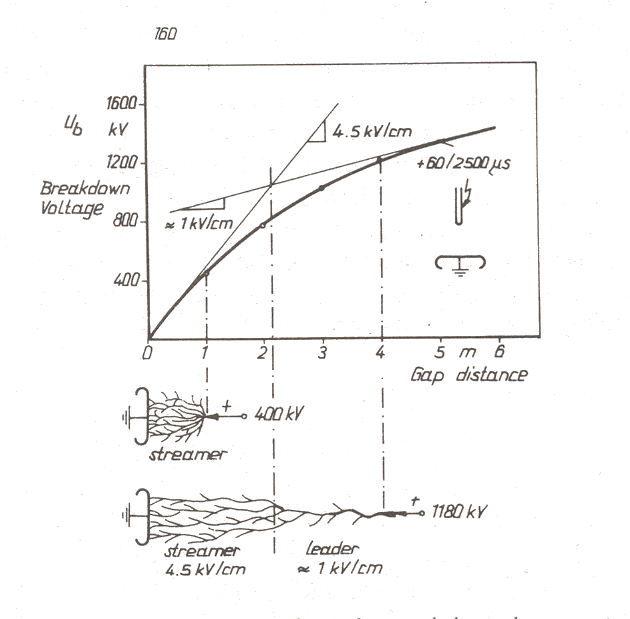 |
Fig 13.6
Relationship between breakdown voltage characteristics and mean potential gradient requirement for the propagation of stable streamer and leader coronas. |