| Breakdown with Stable Star corona |
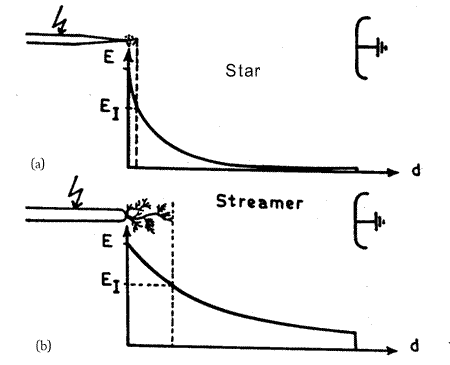
- Unlike uniform and weakly nonuniform fields, in case of extremely nonuniform fields, the process of avalanche formation at the tip of a sharp electrode is not able to grow deeper in the gap towards the opposite electrode because of steep fall in potential gradient at the tip.
|
|
Fig 13.1 Variation of field intensity at needle and rod-plane electrode configurations |
- Hence, the partial breakdown process, in this case, begins at the tip of the sharp electrode. Breakdown with stable avalanche discharge is therefore possible in this case only in very small gap length of a few mm to a few cm range, having a high potential gradient at the electrode. Stable avalanche discharges are possible to be produced only with static dc or slow changing ac power frequency voltages. These provide sufficient time to build a steady space charge field. Under these conditions, the avalanches formed are not able to achieve their critical stage of amplification before the breakdown. With the result, the mean breakdown voltage in the electrode gap acquires comparatively higher value, of the order of 10 to 20 kV/cm (peak) depending upon the polarity of the applied voltage.
|
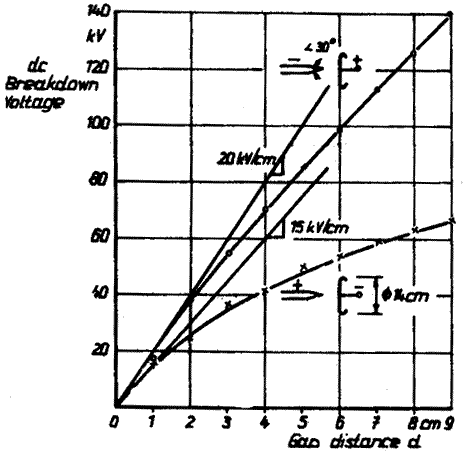
- Uhlmann in his dissertation in 1929 [2.22], measured breakdown voltage characteristics between a 30° point and plane electrode configuration for increasing gap distance with positive as well as negative polarity dc voltages, shown in Fig. 13.2. A strong effect of polarity on the breakdown voltage magnitudes is observed in this case of extremely nonuniform field. The ratio is almost 1:2. The ac (peak) breakdown voltage characteristic would fall nearly in between the positive and negative polarity dc.
|
|
Fig 13.2
dc breakdown voltage characteristics of a 30 o point and a plane of 14 cm dia in air, with respect to increasing gap distance, Uhlmann [ 2.22]. |
- As seen in Fig. 13.2, the average potential gradient required for breakdown decreases as the electrode gap distance is increased. This is because at larger gap distances breakdown with stable pure avalanche discharge is no more possible. One may conclude that for this electrode configuration, breakdown with stable pure avalanche discharge is possible only upto a gap length of about 2 cm. Under these conditions, the average potential gradient for breakdown in the gap is about 10 kV/cm for positive polarity, and 20 kV/cm for negative polarity voltages, as described earlier. At longer gap lengths, where a lower average breakdown potential gradient is required, streamer discharge may commence.
|
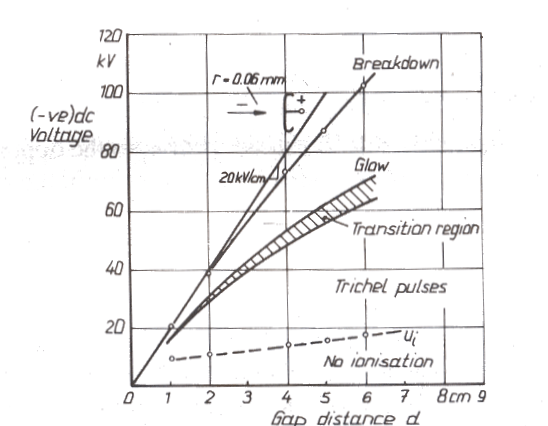
- Similar characteristics were measured for negative polarity point-plane electrode with dc for different gap lengths by Kuffel and Zaengl. The point electrode (cathode) is reported to have a radius of 0.06 mm (Fig. 13.3). Below the lowest curve, no conduction current is measurable. The PB and the Trichel pulse inception voltages, Ui, for increasing gap length are given by this curve. As it can be observed, the gap length does not appreciably change the PB inception voltage. On increasing the voltage applied between the two electrodes, the mode of Trichel pulse does not change over a wide range of voltage. The avalanche process is limited within its critical stage, as explained earlier. A steady and stable partial breakdown phenomenon is observed like a 'star' in the dark. On raising the voltage the PB process at the tip of the sharp electrode intensifies, increasing the current density so much that thermal ionization begins. This gives rise to an unstable leader discharge extending instantaneously towards the opposite electrode, accomplishing a spark breakdown with an arc.
|
| |
|
Fig 13.3 dc negative point-plane breakdown and corona discharge characteristics in atmospheric air, Kuffel [ 2.23]. |
|