Lecture 6 : Properties of vacuum, Related ionization Process
Impact Ionization
Impact or collision of particles amongst each other, accelerated under electrical field, leads to the formation of charge carriers from neutral gas molecules.
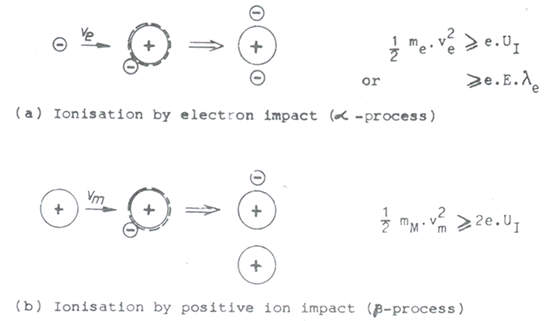
The multiplication of charge carriers in gas takes place mainly by impact of electrons with neutral molecules known as α - process (also primary process).
The positive ions make a moderate contribution to ionization only at solid insulation surfaces, which is known as β - process (also secondary process) shown in Fig. 6.3.
Fig 6.3 Impact ionization by electron and ion
where λe - The mean free path;
e - electron charge;
UI - The ionization potential
The β - process does not play any significant role in gaseous dielectrics during the discharge leading to breakdown.
It is the α -process alone which plays the major role.
When an electron gains more kinetic energy than the required ionization energy W1of the gas molecule, it is capable of ionizing by impact, that is, ejecting an electron from a neutral molecule and thus leaving behind a positive ion.
To cause ionization, the incoming electron must have a kinetic energy greater than or equal to the ionization energy of the molecule (eUI).
However, not all electrons having gained energy ≥ (eUI) cause ionization on collision with neutral molecules. Ionization by impact is actually a probability process.
The mean number of ionizing collisions made by a single electron per centimeter drift across the gap in a uniform field is given by α. It is known as the Townsend's first or primary 'ionization coefficient', which represents basically a probability process. For gas discharge, it is a very important coefficient strongly dependent upon the electric field intensity,