In a gas, the electrons and ions are the electric charge carriers. Ions are produced from neutral molecules or atoms by ejection or attachment of an electron. Ejection of an electron from a neutral molecule leaves behind a positive ion, whereas absorption of an electron by a molecule produces negative ion. The mass of an electron compared to that of a molecule is very less (approximately 1/1840), therefore the mass of an ion can be considered to be equal to the corresponding molecule. Because of the lower mass, the drift velocity of an electron in atmospheric air is ~107 cm/sec, whereas a heavy ion moves with a drift velocity of ~105 cm/sec only. For a small gap distance between electrodes, ions can therefore be assumed not to have moved from the place where they are generated.
During an electrical breakdown, the insulating gas between the electrodes is bridged by a conducting discharge canal (channel). In small gap distance the charge carriers required in order to build this discharge canal are not only produced within the gaseous dielectric across the gap (primary or α- process), but are also released from the electrode surfaces (secondary or γ - process).
The production of charge carriers from the neutral gas molecules is known as ionization process. The ionization process in a gas in long gap distances is the deciding factor leading to breakdown. One of the most significant feature of ionization process is the electron energy in different shells of a molecule. The total energy of an electron while still attached to the molecule, can be divided into two types of energies. First the kinetic energy WKE, which depends upon its mass and velocity, and second the potential energy Wpot depending upon its charge in the Coulomb field of the nucleus of a molecule. These energies are given as,
|

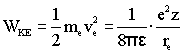 (6.1)
(6.1)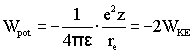 (6.2)
(6.2)  ∞ , the potential energy of the electron tends to be zero. Then the only energy it has, is the kinetic energy acquired externally. The total energy with which an electron is attached to the nucleus of the molecule is given from Equations 6.1 and 6.2 as follows:
 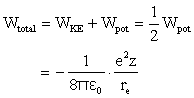 (6.3)
(6.3) 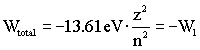 (6.4)
(6.4) 
