Module 3 : Liquid and Solid Dielectrics
Lecture 16 : Permittivity and Polarization in Dielectrics

Permittivity of Insulating Materials


The most important electrical parameter of insulating materials is the capacitance offered by them between given electrode systems. The capacitance thus formed is always accompanied with some losses determined by the permittivity 'ε' and the specific insulation resistanceρins of the material.

The permittivity of an insulating material ε  is defined as the product of absolute permittivity of free space (vacuum) 'εo' and the relative permittivity r' of the material or the medium:

ε = εo εr

The absolute permittivity of free space, εo is constant and has a value,

εo  = 8.854.10 -12 F/m

On the contrary, the relative permittivity of a material εr   is not a constant. It depends upon the thermal conditions of the material as well as the frequency and the magnitude of the applied voltage. εr  is often mentioned as dielectric number or permittivity number in the literature.  εr  of a dielectric is defined as the quotient of the capacitances Cx   to Co, where Cx is the capacitance of a condenser constituting the given material as a dielectric and  Co is the capacitance of the same condenser constituting vacuum as a dielectric in uniform field.

                                                                                                                                                                                                         (16.1)

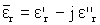
For the mathematical analyses taking into account the polarization process in the dielectrics, it was necessary to introduce the complex relative permittivity '.' described as:

                                                                                                                                                                                            (16.2)

where ε' r  is the real and ε'' r   the imaginary part of the complex relative permittivity , which is also known as 'loss index'.