Series Hybrid System:
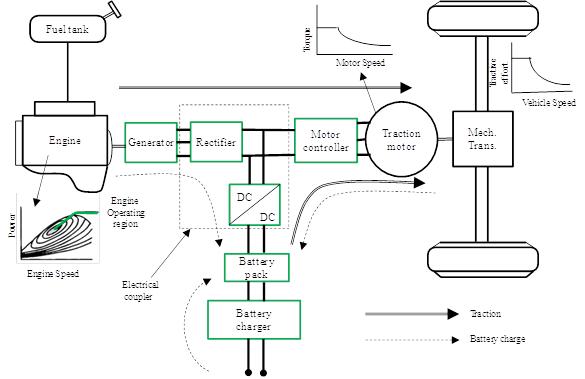
In case of series hybrid system (Figure 4a) the mechanical output is first converted into electricity using a generator. The converted electricity either charges the battery or can bypass the battery to propel the wheels via the motor and mechanical transmission. Conceptually, it is an ICE assisted Electric Vehicle (EV). The advantages of series hybrid drivetrains are:
- • mechanical decoupling between the ICE and driven wheels allows the IC engine operating at its very narrow optimal region as shown in Figure 5.
• nearly ideal torque-speed characteristics of electric motor make multigear transmission unnecessary.
However, a series hybrid drivetrain has the following disadvantages:
- • the energy is converted twice (mechanical to electrical and then to mechanical) and this reduces the overall efficiency.
• Two electric machines are needed and a big traction motor is required because it is the only torque source of the driven wheels.
The series hybrid drivetrain is used in heavy commercial vehicles, military vehicles and buses. The reason is that large vehicles have enough space for the bulky engine/generator system.
-
Figure 5: Detailed Configuration of Series Hybrid Vehicle