A conventional engine-driven vehicle uses its engine to translate fuel energy into shaft power, directing most of this power through the drivetrain to turn the wheels. Much of the heat generated by combustion cannot be used for work and is wasted, both because heat engines have theoretical efficiency limit. Moreover, it is impossible to reach the theoretical efficiency limit because:
- • some heat is lost through cylinder walls before it can do work
• some fuel is burned at less than the highest possible pressure
• fuel is also burned while the engine is experiencing negative load (during braking) or when the vehicle is coasting or at a stop, with the engine idling.
Although part of engine losses would occur under any circumstances, part occurs because in conventional drivetrains, engines are sized to provide very high levels of peak power for the acceleration capability expected by consumers, about 10 times the power required to cruise at 100Km/h. However, the engines are operated at most times at a small fraction of peak power and at these operating points they are quite inefficient.
Having such a large engine also increases the amount of fuel needed to keep the engine operating when the vehicle is stopped or during braking or coasting, and increases losses due to the added weight of the engine, which increases rolling resistance and inertial losses. Even gradeability requirements (example: 55 mph up a 6.5% grade) require only about 60 or 70% of the power needed to accelerate from 0 to 100Km/h in under 12 seconds.
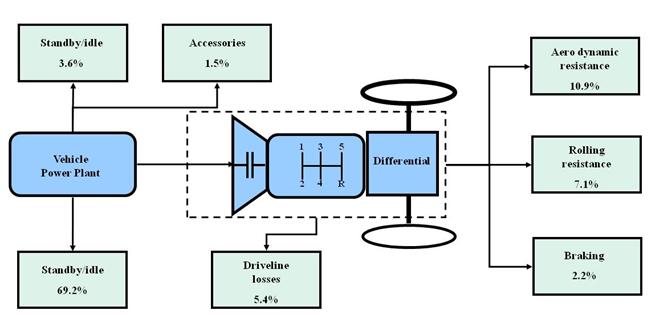
In Figure 1 it is shown how fuel energy is translated into work at the wheels for a typical midsize vehicle in urban and highway driving. From Figure 1 it can be observed that:
- • At best, only 20% of the fuel energy reaches the wheels and is available to overcome the tractive forces, and this is on the highway when idling losses are at a minimum, braking loss is infrequent, and shifting is far less frequent.
• Braking and idling losses are extremely high in urban driving and even higher in more congested driving, e.g., within urban cores during rush hour. Braking loss, represents 46% of all tractive losses in urban driving. Idling losses represent about one sixth of the fuel energy on this cycle.
• Losses to aerodynamic drag, a fifth or less of tractive losses in urban driving, are more than half of the tractive losses during highway driving.
-
Figure 1: Translation of fuel energy into work in a vehicle