Environmental Analysis
Analysis for the first five options was based on published data from manufacturers. The results for the sixth case, i.e. the ammonia-fueled vehicle, were calculated from data published by Ford on the performance of its hydrogen-fueled Ford Focus vehicle. Two environmental impact elements were accounted for in the:
- a. Air pollution (AP) and
b. Greenhouse gas (GHG) emissions.
The main GHGs were CO2 , CH4 , N2O, and SF6 (sulfur hexafluoride), which have GHG impact weighting coefficients relative to CO2 of 1, 21, 310, and 24,900, respectively.
For AP, the airborne pollutants CO, NOX , SOX , and VOCs are assigned the following weighting coefficients: 0.017, 1, 1.3, and 0.64, respectively.
The vehicle production stage contributes to the total life cycle environmental impact through the pollution associated with
- a. The extraction and processing of material resources,
b. Manufacturing and
c. The vehicle disposal stage.
Additional sources of GHG and AP emissions were associated with the fuel production and utilization stages. The environmental impacts of these stages have been evaluated in numerous life cycle assessments of fuel cycles.
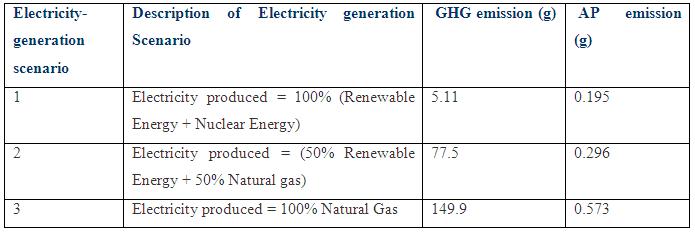
Regarding electricity production for the electric car case, three case scenarios were considered here:
- 1. when electricity is produced from renewable energy sources and nuclear energy;
2. when 50% of the electricity is produced from renewable energy sources and 50% from natural gas at an efficiency of 40%;
3. when electricity is produced from natural gas at an efficiency of 40%.
AP emissions were calculated assuming that GHG emissions for plant manufacturing correspond entirely to natural gas combustion. GHG and AP emissions embedded in manufacturing a natural gas power generation plant were negligible compared to the direct emissions during its utilization. Taking those factors into account, GHG and AP emissions for the three scenarios of electricity generation were presented in Table 2.
Table2: GHG and air pollution emissions per MJ of electricity produced