Corresponding Z-transform:
 |
 |
 |
|
|
 |
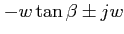
When  = constant, it represents a straight line from the origin at an angle of
  rad, measured from positive real axis as shown in Figure 3 (b).
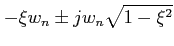
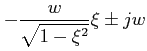
Constant damping ratio loci: If  denotes the damping ratio:
 |
|
 |
|
|
 |
||
|
 |
 is the natural undamped frequency and
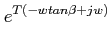
 . If we take Z-transform
|
|
 |
|
|
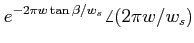 |
For a given or  , the locus in s-plane is shown in Figure 4(a).
In z-plane, the corresponding locus will be a logarithmic spiral as shown in Figure 4(b), except for  or
or  and
and  or
or
 .
.
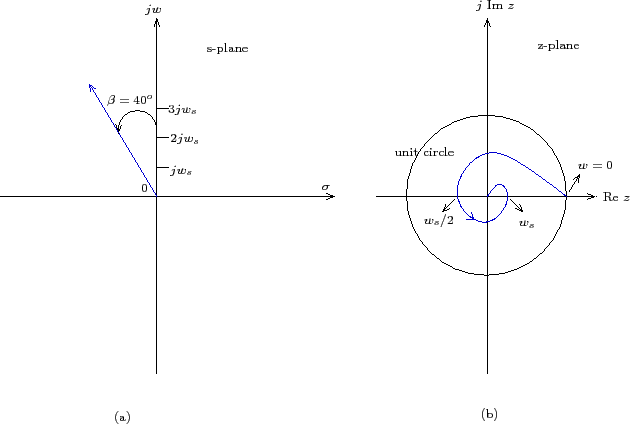
Figure 4: Constant damping ratio locus in (a) s-plane and (b) z-plane