The Controlled Shunt Reactor at Itarsi
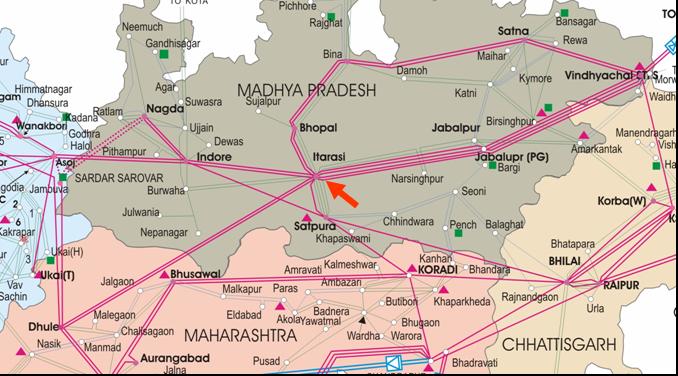
The Itarsi bus in the Western Regional grid of India has several 400 kV long lines (shown in pink in the Figure below) incident on it. These lines carry a large amount of power from the east to the west. However, to prevent over-voltages during light load conditions, reactive power has to absorbed at various buses. During heavy load conditions there is a sag of voltages at buses like Indore. Thus controlled reactive power is desirable rather than having fixed shunt reactors. |
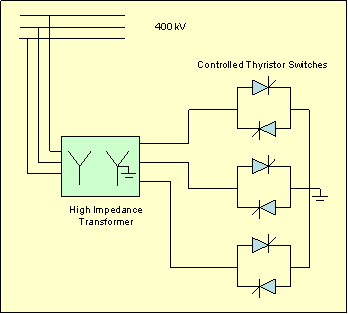
Schematic of the CSR
 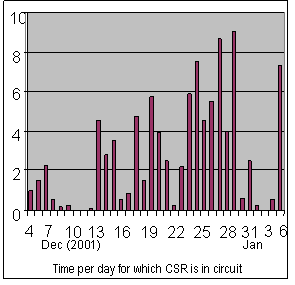
|
We have learnt about shunt reactive control using a thyristor controlled reactor (TCR). Usually, a TCR is connected to a high voltage bus using a transformer. However instead of having a separate reactor, the leakage reactance of a transformer, (which is designed to be high) itself may be utilized thereby achieving some economy. Such a device, denoted as a Controlled Shunt Reactor - CSR- has been designed and implemented by BHEL at Itarsi 400 kV bus in the Western Regional grid of India. The rating of the CSR is 50 MVAr.
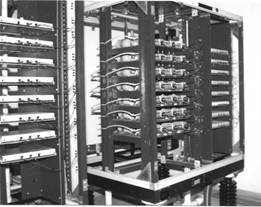
Thyristor Valve for CSR circuit
A CSR provides for controlled reactive compensation only when it is required (i.e. during light load conditions). Unlike fixed reactive compensation which results in voltage sags during heavy load conditions and reduction in power transfer capability, a CSR can be controlled or switched off during heavy load conditions. For example, if the voltage goes above 1.05 pu, then CSR is switched in. The typical response time is of the order of 10 ms.
|
(Details obtained from "Controlled Shunt Reactor : A member of FACTS family", S.V.N. Jithin Sundar et al, 11th NPSC, Bangalore, Dec. 2000, pp 63-68 and "Controlled Shunt Reactor", by Dipak Dutta, International Seminar and Tutorial on Power Transmission Research and Challenges, CPRI, Bangalore, 21-22nd Dec, 2005) |


