There are two types of motion to be considered when generator rotors are subject to transients :
a) Relative motion between generators: Rotor speeds may not be equal during transients. Exchange of power between generators during transients causes relative rotor movement ("swings"). This phenomenon was considered in the previous module. Relative motion dies down if the system is angular stable. Relative motion needs to be stable so that eventually all rotors move together at a common speed.
b) Motion of the center of inertia or the "common motion": If we sum up the swing equations of individual generators, we obtain:
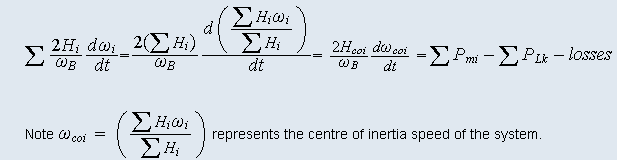
Interestingly, center of Inertia movement is determined ONLY by the load-generation-loss balance. Motion of center of inertia may exist even if there is no relative movement between rotors. Conversely it is possible to have relative motion between generator rotors without center of inertia movement.
|


