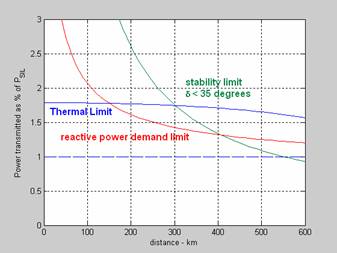
The modified loadability of a line (see a previous example on line loadability) by taking into account stability limits is shown in the figure on the right.
It is not easy to specify stability limits as they depend on the parameters of power system components and the operating conditions. However, for convenience it is specified by the maximum phase angular difference which is allowed across the line.
It is clear that stability is the major constraint for lines more than 300 km long.
|
(click on figure to enlarge) |
A thought which may come to your mind at this point is: if ac interconnections have these constraints (voltage/ angular stability), why not go in for DC transmission especially when transmitting power over long distances? This is an important planning option.
To answer this question dispassionately, let us consider the following points:
1. Long distance transmission requires us to use high voltages and lower currents (otherwise resistive losses will be too large). So step-up will still be required (it is not feasible (as yet) to generate power by ac or dc machines at high voltage). So transformers will be used to step-up generated ac voltage to higher ac voltage, and then rectify it to DC using power electronic converters. DC is again inverted to ac at the receiving end of the line. Thus a dc interconnection will require 2 large ac to dc converters at either end.
2. Voltage profile along a line is not an issue since series inductive and shunt capacitive effects are not manifested in steady state for DC transmission. Resistive drop is usually small.
3. Power Flow can be controlled using firing angle of thyristors used in the rectifier and inverter. Power flow is independent of the phase angular difference between sending(rectifier) and receiving(inverter) ends! So angular stability constraint is not there. In fact if two areas are connected by only dc inter-connections, then even frequency of the two areas need not be the same.
Thermal limit is the only limit for DC transmission lines and loadability is practically independent of distance.
The main disadvantage of dc links is the high cost of the power electronic converters. However, in many cases DC may be most suitable option inspite of the cost. Therefore, you do see several applications of dc links in our country (as an exercise, can you do a survey of this ?).


