| 7.4 |
Cautions in CT Selection
|
| |
While choosing a CT for a particular application, it is necessary to observe following precautions. |
 |
The CT rating and continuous load current should match. For example, if maximum load current is 90A, a 100:5 CT may |
| |
be acceptable but 50:5 is not acceptable. |
|
The maximum fault current should be less than 20 times the CT rated current. For example, 100:5 CT can be used, so |
| |
long as burden on the CT is within the rated values and maximum primary fault current is below 2000A. |
|
The voltage rating of CT should be compatible. For example, 100:5 C100 would give linear response, upto 20 times |
| |
rated current provided CT burden is kept below(100/20 x 5 = 1 ). With 2 burden, this CT can be used only if maximum current is limited to 1000A. ). With 2 burden, this CT can be used only if maximum current is limited to 1000A. |
|
Paralleling of CT's e.g. in differential protection, or with SLG fault can create significant errors in CT performance. One |
| |
should generally ascertain that magnetizing current is kept much below the pick up value. |
| 7.4.1 |
Exercise Problems |
| 1. |
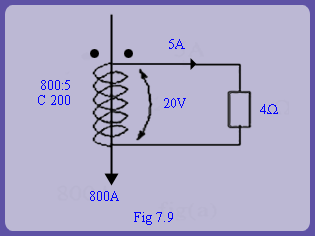
If the current ratio is adequate for a protection, but CT burden is high; then the performance of CT may deteriorate due to |
| |
large magnetizing current and/or saturation problem (see fig 7.9). The CT performance can be improved by connecting the CT's in series (see fig 7.10). |
| |
 |
|
|
Show the dotted terminals for correct secondary series connection in fig 7.10. |
|
What is the VA of CT in fig 7.9 and 7.10 respectively? |
| 2. |
Mark the following statements as true or false: |
|
Electromechanical relays tend to saturate at high currents. This reduces the relay burden on CT, and so that the CT |
| |
performance at moderately high currents may be considered better than at relay's rated burden at 5A. |
|
Use of instantaneous over current relays has the potential to overcome this problem of saturation of CT's. |
|
Differential protection can operate on external faults due to the unequal saturation of CT's. |
| |
|


