As a consequence of CT core saturation, the secondary current would not faithfully replicate the primary current. In fact, in practice it is observed that CT secondary current is clipped as shown in fig 7.8. The clipping of CT current leads to “blinding” of the relay which cannot function any further. Hence, CT saturation in presence of dc offset current is a serious problem which relay designers have to face.
Note that dc flux accumulates gradually. In fact it depends upon the transmission line time constant (). It is apparent that saturation should not occur immediately after the inception of the fault. Thus, if the relay is fast enough in decision making, it is likely that a relaying decision would be undertaken before the CT fully saturates. This is another important reason for demanding speed from the relaying system.
For bus-fault protection, where the CT saturation due to dc offset current can be a significant contributing factor, quarter cycle operations specification are imposed. Similarly, a distance relay is expected to operate within cycle time.

 ). It is apparent that saturation should not occur immediately after the inception of the fault. Thus, if the relay is fast enough in decision making, it is likely that a relaying decision would be undertaken before the CT fully saturates. This is another important reason for demanding speed from the relaying system.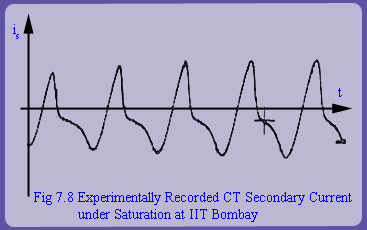
 cycle time.
