Module 1 : Fundamentals of Power System Protection
Lecture 3 : Protection Paradigms - System Protection
3.3
Lightning Protection
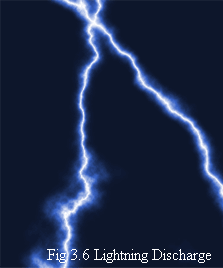
Many line outages result from lightning strokes that hit overhead transmission lines. Lightning discharges normally produce overvoltage surges which may last for a fraction of second and are extremely harmful. The line outages can be reduced to an acceptable level by protection schemes like installation of earth wires and earthing of the towers.
Lightning overvoltages can be classified as follows:
Induced overvoltages which occur when lightning strokes reach the ground near the line.
Overvoltages due to shielding failures that occur when lightning strokes reach the phase conductors.
Overvoltages by back flashovers that occur when lightning stroke reaches the tower or the shield wire.
The most commonly used devices for protection against lightning surges are the following:
Shielding by earth wires: Normally, transmission lines are equipped with earth wires to shield against lightning
discharges. The earthwires are placed above the line conductor at such a position that the lightning strokes are intercepted by them. In addition to this, earthing of tower is also essential.
Lightning Arrestors: An alternative to the use of earthwire for protection of conductors against direct lightning strokes is
to use lightning arrestors in parallel to insulator strings. Use of lightning arrestors is more economical also.
ZnO varistor is commonly used as lightning arrestor because of its peculiar resistance characteristic. Its resistance varies with applied voltage, i.e, its resistance is a nonlinear inverse function of applied voltage. At normal voltage its resistance is high. But when high voltage surges like lightning strokes appear across the varistor, its resistance decreases drastically to a very low value and the energy is dissipated in it, giving protection against lightning.