Module 1 : Fundamentals of Power System Protection
Lecture 3 : Protection Paradigms - System Protection
3.2.3 Reverse Power Relay


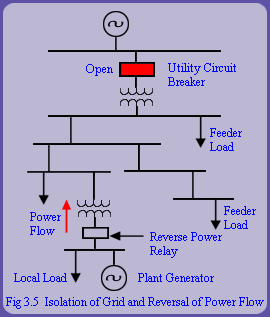
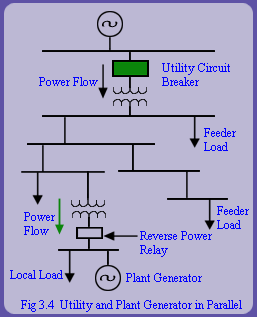
  Distribution systems are radial in nature. This holds true for both utility and plant distribution systems. If there is a fault on the utility's distribution system, it may trip a breaker thereby isolating plant from the grid. This plant may still remain connected with downstream loads as shown in fig 3.4 and 3.5. Consequently, power will flow from the plant generator to these loads.
 

If in the prefault state, power was being fed to the plant, then this reversal of power flow can be used to island the plant generation and load from the remaining system. This approach is useful to detect loss of grid supply whenever the difference between load and available generation is not sufficient to obtain an appreciable rate of change of frequency but the active power continues to flow into the grid to feed the external loads.

  Example
 

In fig 3.4, consider that the plant imports at all times a minimum power of 5 MW. Studies indicate that for various faults in utility side, minimum power export from the plant generator is 0.5 MW. Deduce the setting of reverse power relay. If the plant generator is of 50 MW capacity, what is likelihood of underfrequency or rate of change of frequency relay picking up on such faults?
Ans: Reverse power flow relay can be set to 0.4 MW. Since minimum reverse power flow is 1% of plant capacity, it is quite likely, that utility disconnection may not be noticed by underfrequency or the rate of change of frequency relays.
Vector shift relays and system protection schemes in transmission systems will be discussed in more details in later lectures.

 
5