| 3.1 |
Overview of Power System Dynamics |
| |
Usually, system protection requires study of the system dynamics and control. To understand issues in system protection, we overview dynamical nature of the power system. Power system behavior can be described in terms of differential and algebraic system of equations. Differential equations can be written to describe behaviour of generators, transmission lines, motors, transformers etc. The detailing depends upon the time scale of investigation. |
| |
|
| |
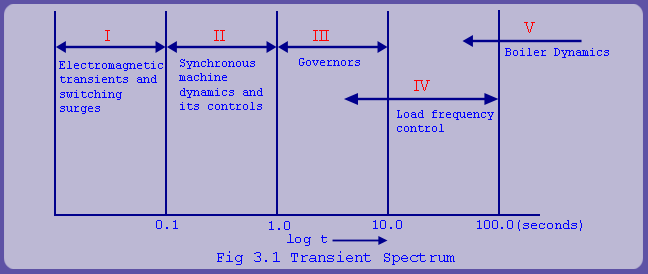
Figure 3.1 shows the various time scales involved in modelling system dynamics. The dynamics involved in switching, lightening, load rejection etc have a high frequency component which die down quickly. In analysis of such dynamics, differential equations associated with inductances and capacitances of transmission lines have to be modelled. Such analysis is restricted to a few cycles. It is done by Electromagnetic Transient Program (EMTP).
At a larger time scale (order of seconds), response of the electromechanical elements is perceived. These transients are typically excited by faults which disturb the system equilibrium by upsetting the generator-load balance in the system. As a consequence of fault, electrical power output reduces instantaneously while the mechanical input does not change instantaneously. The resulting imbalance in power (and torque) excites the electromechanical transients which are essentially slow because of the inertia of the mechanical elements (rotor etc).
Detection and removal of fault is the task of the protection system (apparatus protection). Post-fault, the system may or may not return to an equilibrium position. Transient stability studies are required to determine the post fault system stability. In practice, out-of-step relaying, under frequency load shedding, islanding etc are the measures used to enhance system stability and prevent blackouts. The distinction between system protection and control (e.g. damping of power swings) is a finer one. In the today's world of Integrated Control and Protection Systems (ICPS), this distinction does not make much sense. In this lecture, we discuss these issues from distribution system perspective. In the next lecture, a transmission system perspective will be discussed. |
| |
|
|


