Adding Shadows:
Look at a bunch of grapes as a group of spheres. We can place all the shadow areas of the grapes (form shadows) on the sides that are opposite the light source. Then can also block in the shadows that the grapes throw on one another and on the surrounding surface (cast shadows).
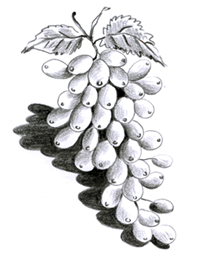
Fig. 80: Adding shadows to sketches based on the source of light.
Drawing Cast Shadows:
Cast shadows are important in drawing for two reasons. First, they anchor the image, so that it does not seem to be floating in air. Second, they add visual interest and help link objects together. When drawing a cast shadow, we must keep in mind that its shape will depend on the light source as well as on the shape of the object casting it. For example, as shown below (Fig.81), a sphere casts a round or elliptical shadow on a smooth surface, depending on the angle of the light source. The length of the shadow is also affected: the lower the light source, the longer the shadow.
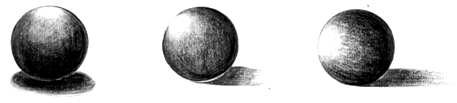
Fig. 81: Casting shadows.
|

