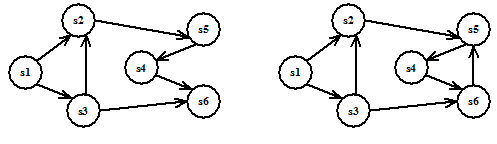
Figure 14a.Invalid Kripke Structure Figure14b.Valid Kripke Structure
Semantics of CTL is defined by a relation  on state s, over formulaφ on model M , which is written as “s mφ”—this implies CTL formula φ holds in state s of model M . CTL formulas are interpreted over Kripke structure after unfolding it as tree. Figure 15 shows a Kripke structure, where the set of atomic propositions is P={p,q,r} . The model in terms of the parameters discussed above is as follows
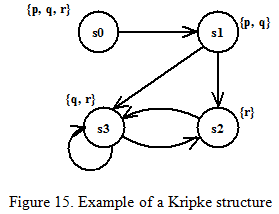
• S= {s0,s1,s2,s3}
•  ={{s0, s1}, {s1,s2}, {s1, s3}, {s2,s3}, {s3,s2},{s3,s3}}.
• L: L(s0)={p,q,r}, L(s1)={p, q}, L(s2)={r}, L(s3)={q, r}.
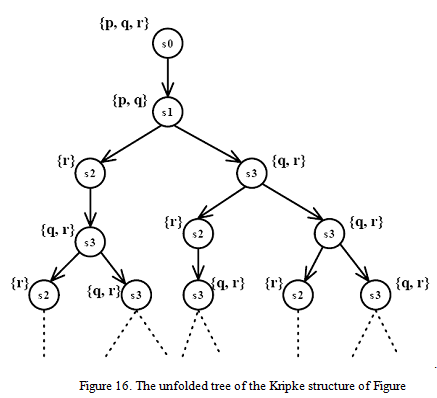
Figure 16 shows the tree of the Kripke structure of Figure 15, when it is unfolded over time.
To determine whether s φ on M holds, requires a recursive procedure on the structure of φ , which is discussed as follows:
• Ifφ is atomic, satisfaction is determined by L . For example, if φ is atomic p say, then its truth at a state s can be determined by looking at the labels at s .
• If the root in the parse tree of f is a Boolean connective ( 
 etc.) then the satisfaction of s φ is answered by the usual truth-table definition and further recursion down φ . For example, if φ is “ AX
  p ” say, then its truth at a state s can be determined by truth table value of p and then evaluating AX on the result.
• If the top level connective of f is a path operator beginning with A (E) , then satisfaction holds if all (there exists at least one) paths from s satisfy that formula resulting from removal of A (E) . If the result of removing A or E contain further A s or E s, they will be dealt with by recursion.